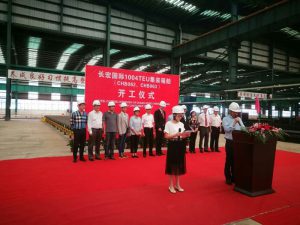
FORAN used to design new boxship at Chinese shipyard
OCTOBER 24, 2016— The steel cutting ceremony for the first project designed with Sener’s FORAN system by CIMC Ocean Engineering Design and Research Institute Co., Ltd. (CIM ORIC) was held in the
OCTOBER 24, 2016— The steel cutting ceremony for the first project designed with Sener’s FORAN system by CIMC Ocean Engineering Design and Research Institute Co., Ltd. (CIM ORIC) was held in the
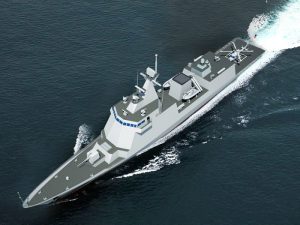
OCTOBER 24, 2016—Korean shipbuilder Hyundai Heavy Industries (HHI) has signed a contract to build two 2,600 ton frigates with the Department of National Defense, Republic of the Philippines. The recent signing ceremony
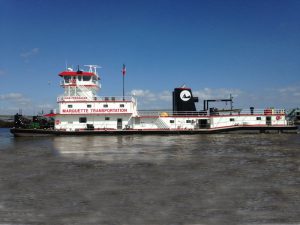
OCTOBER 18, 2016—This past September, the Houma, LA, shipyard of Gulf Island Shipyards, a division of Gulf Island Fabrication, Inc., delivered the 10,000 hp M/V Chad Pregracke, the last of a series
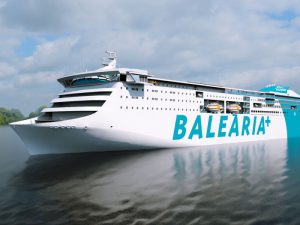
OCTOBER 14, 2016—A new Ropax vessel under construction at LaNaval shipyard in Spain will be the Mediterranean’s first gas-fueled ferry and will feature an extensive array of Wärtsilä propulsion equipment and Liquefied
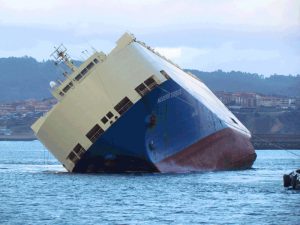
On January 29, 2016, the Roll-On/Roll-Off (RO/RO) carrier Modern Express, a Panama-registered ship transporting 3,600 tonnes of wood and construction machinery from Gabon to France, was caught in as severe storm in the Bay of Biscay. Battered by huge waves, the vessel developed a severe list and lost engine power. The captain sent out a distress signal, and the vessel’s 22 crew members were airlifted to safety by two Spanish helicopters, leaving Modern Express to founder in heavy seas without crew or power.
Rapid response team SMIT Salvage, a Dutch salvage and towing company that specializes in emergency operations, was called to handle the case, and the DNV GL ERS team was activated.Within hours, SMIT had chartered two heavy tugboats to secure the vessel and had a ten-man salvage crew on the scene. DNV GL put three technical experts on the case to provide advice on stability and structural strength issues based on the original vessel drawings and a predefined 3D computer model.
Aware that the wind and sea conditions were pushing Modern Express towards the southwestern coast of France, the SMIT team attempted to attach a tow line to the stricken vessel. Rough seas made this impossible, but on February 1, four SMIT salvage experts were lowered onto the deck of Modern Express by a helicopter, where they were able to attach towlines. This allowed a tug to turn the vessel and steer it away from immediate danger. While no personnel were injured during the operation and the loss of the vessel was no longer an immediate threat, the job was far from over, and the focus of the operation shifted to guiding the vessel to a safe port.
Safe harbor
“Our first priority in a crisis situation is to carry out the necessary calculations to assess the condition of the vessel and to advise personnel on-site how best to manage the crisis,” says Øyvind Træthaug, Principal Engineer Emergency Response Service at DNV GL.“Together, our duty teams in Oslo and Hamburg handle about 40 cases a year. Not all require salvage operations, but when they do, we try to support the efforts of the salvors. We have worked extensively with SMIT in the past, and have developed a good, cooperative relationship with them.”
According to Richard Janssen, Commercial Direct or of SMIT Salvage, the greatest challenge in any salvage operation is gaining timely access to reliable information. “Until we get people on board to assess the condition of the vessel itself, it is difficult to get an accurate picture of what we are dealing with,” he says. “The stability calculations we receive from the class of the vessel, combined with analysis from our own team, can make a big difference in how we approach salvage operations.”

Challenging conditions
Janssen says that the greatest challenge in any emergency salvage operation is coordinating the flow of information between various stakeholders. “In a case like this, we work with the owner, local maritime authorities, lawyers and underwriters to coordinate our response. We received excellent support from DNV GL in this situation,” says Janssen, adding that the hands-on assessment of the vessel’s condition was difficult. “The vessel was listing at 40 degrees, with some decks partially submerged, making it difficult for our experts to assess structural damage.However, DNV GL’s calculations helped confirm our own analysis of the vessel’s condition and we agreed the ship was seaworthy enough to be towed.”
Righting the ship
After having applied for a place of refuge in accordance with the new EU Operational Guidelines, the Spanish authorities gave their approval by February 2 for Modern Express to head for the harbor entrance in the Port of Bilbao in Spain, where a boarding team of eight SMIT salvors were put onto the vessel to connect up additional tugs for berthing.The vessel was secured to the dock with specialized shore-tension equipment after the necessary inspections could be carried out.The next challenge was how to right the ship.
“We discussed using counterweights to bring the ship upright, but as the SMIT team was able to assess the vessel more thoroughly, we verified and helped SMIT to improve a nine-step dewatering sequence using pumps and ballast tanks to gradually right the ship,” says Træthaug, who was very happy with the result.Work began on February 6 and the team managed to reduce the vessel’s list from 51 degrees to zero.
“We measure the quality of our service in how quickly we can produce and deliver useful information and recommendations for decision support in critical situations,” adds Rossen Panev, a DNV GL Principal Engineer who collaborated on the case with Træthaug. “Working closely with salvors like SMIT gives us the opportunity to enhance each other’s skill sets and provide the customer with the best possible advice when the pressure is on and they need to make fast decisions.”
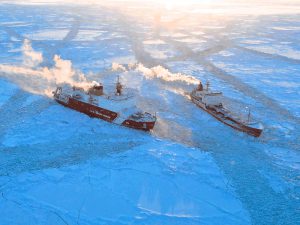
It was a nasty winter, even by Alaskan standards. The city of Nome, Alaska was in trouble. A late November storm blocked a scheduled shipment and the city was running out of fuel. In an Arctic winter, fuel is as precious as blood. It powers more than cars and trucks, it runs generators to light up the 24 hours of darkness and it burns in boilers for heat when the outside temperatures regularly hit -50 degrees. Without fuel, all human life stops; and Nome’s tanks were running dry. The solution to the crisis lay in the belly of a Russian ice-strengthened tanker sailing just offshore. The problem was that her cargo of life-sustaining gas and diesel was loaded in Dutch Harbor Alaska, and a U.S. law designed to protect domestic shipbuilding was preventing her from completing the mission. Recognizing the urgency, Secretary of Homeland Security, Janet Napolitano, issued a one-time waiver of the Jones Act and the Renda steamed into Nome Harbor to deliver the fuel.
As changes in Arctic continue to unfold, incidents such as the one in Nome will become more common. In addition, the pace of change in Arctic has found the U.S. unprepared to assert her claims and to defend fragile ecosystems and populations. The Nome incident illustrates a stark choice for the U.S.: change how the country protects its domestic shipbuilding, or cede the Arctic to its geopolitical rivals.
The Jones Act requires that any ship carrying passengers or cargo between two U.S. ports must be built in the U.S., crewed by U.S. nationals, and owned by a U.S. company. The Act dates back to the 1920’s but the idea of protecting a domestic shipbuilding industry from foreign competition is as old as the country itself. The First Congress of the United States levied heavy tariffs on goods delivered on foreign ships. The Act serves that important role today; however, the economic reality is that Jones Act compliant ships are expensive to build and expensive to operate. So to maximize profits, large ships in the international trade are flagged in countries with favorable laws and tax treatment. Such “flags of convenience” create strange outcomes as cruise ships that pick up vacationers in Miami must first stop somewhere outside of the U.S. before discharging their passengers. Foreign flagged tankers, loading crude in Valdez may take that crude to a foreign port where it is pumped ashore, modified slightly, then reloaded on to the same ship before that ship sets sail for a U.S. refinery.
Opponents of the Jones Act point out the inefficiencies created when non-compliant vessels seek to skirt the law. They argue that the trade protection measure makes coastwise shipping prohibitively expensive as shipbuilders in the U.S. must operate under more expensive environmental and labor regulations. Similarly, the U.S. ownership requirement cuts off sources of capital to build those ships. Without the Jones Act, the argument goes, we could use international competition and realize benefits and efficiencies of moving freight over water. For example, we could put containers on barges that service coastal cities, thereby removing thousands of trucks from the already choked and crumbling interstate highways.
Proponents of the Act cite jobs and national security interests. During World War II the U.S. shipbuilding industry saved the world from fascism by building Liberty Ships faster than German submarines could sink them. Today, the market for Jones Act compliant vessels supports thousands of good paying jobs and preserves skills that would desperately be needed should the world face a similar crisis. The decline in domestic manufacturing under the auspices of free trade serve as a warning to those looking to open U.S. shipbuilding to foreign competition.
The Arctic presents a different problem. As the ice recedes, human demands in the Arctic will increase. Just this year, 1,000 passengers aboard the cruise ship Crystal Serenity sambaed and bunny hopped their way through the once impassable Northwest Passage. As a result of increased economic activity, settlements in the Arctic will grow. More people in the Arctic means more demand for ice class ships to resupply villages and outposts. More shipping also means increased demand for search and rescue and spill response. As demand for icebreakers and ice class ships increases, there are few Jones-Act certified ships to fill the need. In contrast, countries such as Finland have an excess of icebreaker capacity. Those ships, however, cannot operate between U.S. ports in the absence of a Jones Act waiver from the Department of Homeland Security.
In addition to support for economic activity, presence in the Arctic is critical for political reasons. Conditions in the Arctic are changing faster than most expected and wherever the ice recedes, it leaves behind a geopolitical vacuum. As the ice pulls back from the shore, it will expose trillions of dollars in natural resources. More importantly, it will uncover fragile and delicate ecosystems and leave indigenous populations exposed to potential exploitation. Russia has already staked its claim to a vast undersea territory stretching almost to the North Pole. In the last few years, Russia has been quietly rebuilding its fleet of Soviet era icebreakers. Today, Russia has scores of ice class ships, six nuclear powered icebreakers, and three more heavy crushers on their way. China, with no territory in the arctic, has two icebreakers with a third on the way. The United States, a country with the world’s most powerful and well equipped military, has one heavy icebreaker, and it is 40 years old. Congress has allocated funds for a second ship, but construction will not start until 2020 and the ship will not see ice until 2025. Protection of the environment and native people in the Arctic will require a U.S. presence and a U.S. presence will require icebreakers now.
Typical Jones Act problems involve competition between foreign and U.S. flagged ships. But with little or no U.S. ships to fill the need, the Jones Act forces a choice between using a foreign flagged vessel or nothing at all. As the situation in Nome demonstrated, that is not a choice when lives, the environment, or a critical national interest is at stake. The current administration can fix this. The Secretary of Homeland Security, using executive authority, can and should grant a temporary waiver for all ice class vessels operating from the Aleutian Islands in the south to the Canadian border in the north and in all U.S. points above the Arctic Circle, until such time as an equivalent Jones Act compliant vessel becomes available. Such a rule would allow the U.S. to immediately defend her geopolitical interests by freeing up the one available icebreaker. While the waiver is in place, existing foreign vessels could develop and test markets for commercial shipping with ice breaking capabilities. If it appears the market will bear the increased cost of a U.S. flagged ship providing those services, U.S. shipbuilders will build a ship and enter the market. When the U.S. ships move in, the waiver is lifted and the U.S. will protect that market under existing law. In this way, the rule would actually promote domestic shipbuilding by allowing other countries to highlight areas for growth while minimizing risks. Such a rule would also encourage efficiency and innovation without compromising or threatening existing jobs.
As President Lincoln said in his 1862 address to Congress “the dogmas of the past are inadequate to the stormy present.” The Arctic presents opportunities and challenges not seen by western countries since the days of Columbus. In times of crisis, we can, and should, look critically upon institutions fostered in a different time and for a different reason. The Secretary of Homeland Security recognized this crisis and granted a waiver for Nome. The Secretary should now do the same for the rest of the Arctic.
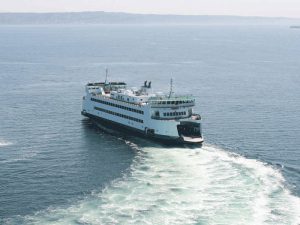
“Legally, a ferry is the continuation or prolongation of a highway over a navigable stream.” This quote is from the first Transactions of the Society of Naval Architects and Marine Engineers (SNAME), published in 1893. Given the impact of ferries upon society, it should come as no surprise that they have been a topic of interest to many naval architects for many years. The Pacific Northwest region of the United States contains a mix of islands, rivers, peninsulas and lakes. Salt water and fresh water transportation routes have been a critical part of the economic development of the region beginning with the native peoples and continuing today. Since the arrival of the first settlers in the 1850’s, power-driven ferries have been a common sight, linking the various communities through the movement of goods and people.
What is a double-ended ferry and why choose this configuration? A double-ended ferry is one where vehicles are loaded on and off both ends of the vessel and the direction of travel switches so the bow becomes the stern. The greatest argument for a double-ended ferry is when the route is short such as a river crossing. The time to maneuver the vessel so it can back in to the dock becomes a significant portion of the overall time between departures. The maneuvering time also consumes additional fuel and imposes the risk, however small, of any maneuver going awry. Another advantage is that the vessel will have the same handling characteristics every time it enters or departs a terminal. With its propulsion at each end, the double-ended ferry has excellent stopping power and superior maneuverability, especially if using an azimuthing or cycloidal propulsion system. This all contributes to safety, a critical factor for any ferry.
The origins of Elliott Bay Design Group (EBDG) go back to the late 1920’s with the establishment of W.C. Nickum & Sons. The earliest ferry projects were to modify the double-ended ferries from the San Francisco Bay area that were made superfluous by the bridge building activities there in the 1930s. Since that time EBDG has worked on a wide variety of vessel sizes and propulsion types, to suit routes ranging from short river crossings to 20 nautical mile transits of exposed water.

The typical ferry we have designed has a V hull amidships with a narrow, flat of bottom at baseline. The side shell flares outboard with one or two knuckles between the heavy guard at the deck edge and the bottom. This configuration produces surfaces that are fully developable which facilitates construction. Typically, the waterline beam is 80% of the maximum beam. This shape provides excellent reserve buoyancy for damage stability and adds waterplane area as the vessel heels, thus improving intact stability. Where there is a draft limit, we increase the width of the flat of bottom. At the ends the waterline shape typically narrows to a fine entrance. Because the waterline beam decreases more quickly than the beam at deck, the effect is to create substantial sponsons. These are located sufficiently far above the bow wave to avoid increased wetted surface as the bow wave increases with speed. The shape of these sponsons also needs to consider wave slamming in rough weather, so a compromise is sometimes required between calm water resistance and speed in waves. The lower part of the hull at the ends is fitted with a skeg to support the shaftline (with traditional shafting on centerline) and to support the hull in dry dock. The skeg shape and volume are critical to the shape of the bow wave, hence we carefully consider the section area shape, including skegs. In more recent projects we have seen greater emphasis on reducing hull resistance, especially for ferries that operate on route lengths of greater than 2 nautical miles. Over the 40 to 50 year life of a ferry, small reductions in drag can result in significant fuel savings, and of increasing importance, lower emissions. Through the use of computational fluid dynamics we can find a balance between low resistance and ease of construction.
The double-ended ferry lends itself to a wide variety of propulsion configurations. Historically, these have ranged from steam-driven, side paddlewheels to a cable ferry powered by horses on a treadmill. In more recent times, we have seen the diesel engine become the dominant power source with a variety of means of putting the power into the water. Clearly, there is no preferred approach that works for every ferry. As designers, we look for the machinery configuration that meets the owner’s performance requirements with the best balance between reliability, maintainability, fuel efficiency and operability. This search typically takes the form of a propulsion study where we work with the owner to establish weighting criteria for the various aspects of the propulsion system. Typically, an owner will have strong opinions on what equipment and what configuration works well for his operation.
We are also seeing more clients interested in different forms of propulsion to reduce their overall energy consumption and thus reduce their environmental footprint. Owners are willing to trade off the simplicity and reliability of traditional geared diesel propulsion for reduced energy consumption through use of hybrid propulsion with electric drives, batteries for energy storage, and smart control systems. We are also seeing increased interest in alternative fuels such as liquefied natural gas, biofuels, and even hydrogen.
This year EBDG developed a physics-based simulation tool to evaluate different propulsion technologies for different sizes of ferries operating on different types of routes. This tool calculates hull resistance, weights, fuel requirements, and hull characteristics in an iterative fashion until the basic parameters of weight and buoyancy are in balance. The outputs from the tool are estimates of capital and operating costs as well as carbon emissions. We can now work with ferry operators to assess the economics of using technology to reduce environmental impacts.
So, what has 50 years taught us? First is that there always will be opportunities to improve the art of double-ended ferry design. Some recent trends include:
Signed into law by President George Bush in December 2007, the Energy Independence and Security Act of 2007 was to have achieved important, long-sought maritime sector objectives. A national Short Sea Transportation (SST) program was authorized and a detailed outline provided. The Secretary of Transportation was assigned the responsibility for the development a plan for SST implementation, and required to report to Congress by December 2008 on the progress made.
The 2007 Act mandated Secretarial action to create an environment that would attract private sector investment to finance SST requirements. The original House version of the 2007 Act, as reported by the House Committee on Transportation and Infrastructure and passed by the House on January 18, 2007, addressed the need for government-assisted SST financing by extending the Maritime Administration (MARAD) capital construction fund (CCF) tax-deferral program to container and ro/ro services nationwide, and by authorizing $2 billion for the MARAD Title XI program use in attracting private sector financing for SST projects.
Mr. Oberstar and his Congressional co-sponsors of the original maritime sections of the 2007 Act were confident that with their proposals in place, the long-discussed use of U.S. waterways for the transportation of freight (in containers and trailers) and passengers, to mitigate landside highway congestion and reduce petroleum usage, and accomplish multiple other objectives, would be underway.
They were to be disappointed. The $2 billion of Title XI authorization was removed in the Senate. The Secretary’s report, required by December 2008, was not delivered until April 2011 and concluded that without “strong leadership from the federal government . . . the nation’s rivers and coastal waterways will continue to be underutilized for domestic container and trailer freight transportation” without tabling such leadership proposals.
And, after the 2007 Act had become law, when U.S. ferry operators sought to include their vessels that carried passengers as well as ro/ro cargoes, so-called ro/pax vessels, for CCF program “qualified” withdrawals, MARAD refused to approve these withdrawals. MARAD advised CCF program applicants that Congress had intended the 2007 Act extension to apply for only to vessels in ro/ro services engaged in the carriage of freight, and that the carriage of passengers, in so-called ro/pax vessels, was a disqualification. And, CCF program applicants were told that a new Congressional enactment would be required to enable MARAD to include ro/ro vessels that included the carriage of passengers as “qualified” services.
Change of Policy
This MARAD interpretation has been withdrawn. MARAD will now include ro/ro vessels that also carry passengers, ro/pax vessels, as engaged in CCF program “qualified” services. Owner and operator participants in the MARAD CCF program will be now able to use their CCF program deposits to purchase ro/pax vessels, and retire ro/pax vessel debt. And, this will enable shipyards that are building ro/pax vessels to use their CCF program monies as working capital for construction financing for customers (or for their own accounts) and as equity in customer vessel leasing transactions.
The majority of U.S. vehicle ferry services are provided by vessels that carry vehicles and freight loaded by “wheeled transportation technology” and vehicle drivers and passengers being loaded in this same fashion, plus additional walk-on passengers. It was to facilitate the construction of these vessels that the CCF program qualifying service definition was being expanded. This MARAD change in interpretation gives full recognition to the CCF extension that Congress intended in 2007. It is of enormous practical importance.
MARAD CCF Program & Importance
The MARAD CCF program allows participants to defer payment of federal and state income taxes on vessel operations and sales and associated investment income. It provides what is in-effect an interest-free loan of monies that a taxpayer would otherwise pay to settle current taxes in exchange for the taxpayer’s promise to use that money for the construction of vessels to be operated in qualifying services or the payment of exiting or later incurred vessel debt. MARAD currently lists 165 CCF program participants. These include owner-operators such as Crowley Maritime, Exxon Corporation, Matson Navigation and Tote, two shipyards NASSCO and Horizon Shipbuilding, and what are apparently three owner-lessors. As of 2012 year-end, MARAD recorded $2.3 billion of CCF program monies as on deposit. Many of the owner-operator participations date from the 1970s. NASSCO was the first CCF shipyard, entering the program in 1988, and remains a participant today. NASSCO has apparently been able to defer federal and California tax on the profits from almost all of its U.S. new-buildings, and to use these interest free borrowings as working capital in the construction of vessels for customers in the Alaska, Hawaii and Puerto Rico (non-contiguous) trades.
This MARAD program change will allow commercial operators to defer tax and access their CCF monies as working capital for new ro/pax construction. The change will not directly benefit state and municipal owner-operators such as Washington State Ferries that do not need to defer taxation of current income. However, the CCF program can now be employed by the shipyards from which these owner-operators purchase their ro/pax vessels. These shipyards can use their CCF monies as a source of working capital to provide construction period financing, and equity for long term lease financing. And owner-operators like WSF, may be able to obtain CCF program ro/pax long-term charter rates that will be 30 to 40 percent lower than the long-term charter rates that would otherwise be available. This might become a factor in lease vs. purchase decisions for operators like WSF that have substantial fleet replacement needs.
The greatest number of immediate beneficiaries of this MARAD change will be the U.S. citizen shipyards that are engaged in, or are considering engaging in ro/pax vessel construction.

Mr. Cook was the MARAD General Counsel who was responsible for the 1970 Act CCF Program implementation. His work with the Program has included advice for both private sector clients and in U.S. Government projects (in work for MARAD itself and for the U.S. Navy) and is partially detailed at his www.CookMaritimeFinance.com website and in the site’s linked documents.
If you would like a copy of his PowerPoint slide set on “Sheltering Shipyard Profits to Benefit Customers,” or of his descriptive memo hand-out “MARAD CCF: Shipyard Program Use” please email him at Cook@CookMaritimeFinance.com. For more information on the Program, you can also contact Mr. Daniel Ladd, at MARAD’s “Office of Financial Approvals” at 202 366 5737 or Daniel.Ladd@dot.gov.
A follow-on article by Mr. Cook with examples of shipyard and owner-operator CCF Program use is scheduled for the MARINE LOG November issue.
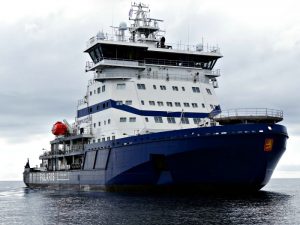
SEPTEMBER 28, 2016—While the U.S. is still years away from building a new heavy icebreaker for its fleet, the Finnish Transport Agency took delivery today of the I/B Polaris, first icebreaker capable
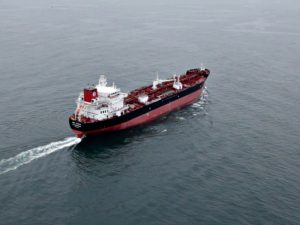
SEPTEMBER 28, 2016—Yesterday, General Dynamics NASSCO, San Diego, CA, delivered the 50,000 dwt Bay State, the fourth vessel in a series of five ECO Class product tankers under contract with American Petroleum