Marcon brokers sale of 1988-built deck barge

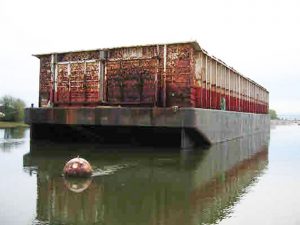
The 5,450 dwt chip barge was built as a flat deck barge by West Gulf Marine Works in Galveston, TX in 1988 and brought around to the West Coast by Zidell Marine of Portland, OR. The barge was constructed with ½” plate deck, hull and bottom plate with two longitudinal and six transverse bulkheads forming 21 watertight compartments. In the late 1990s, Dunlap fitted the DT-250 with a 237′ long x 65′ wide steel chip bin. It installed a new wood wear deck in 2014.

Island Tug & Barge is renaming the barge ITB-253 and plans to shorten the present 22′ high bin walls and remove the existing wood wear deck, replacing it with concrete and rebar which will also increase the barge’s existing 1,500 lb/sq.ft deck load.

The barge is classed ABS +A1 Barge, Unrestricted Service through February 2018 and carries an International Load Line Certificate.

Marcon acted as sole broker in the sale and has represented the buyers in dozens of sales and purchases. It has also worked with Dunlap for many years and sold its 3,000 HP tug Suiattle earlier this year.

Marcon has brokered twenty-nine sales and charters to date this year, including seven ocean deck barges totaling 34,964 dwt. Several additional sales are pending.

Robert Allan designs new RAmparts tug for Chile’s SAAM


The first two boats, named Chincha and Tupac, are now under construction at the Wuxi Shipyard in China, for SAAM’s Peruvian affiliate Tramarsa, with others soon to follow.

In addition to the design, Robert Allan Ltd. also provided a complete structural steel parts package developed from the design drawings prepared for this project. Parts were defined and nested using ShipConstructor software, complete with part identification code, suitable as input to the shipbuilder’s NC burning code.

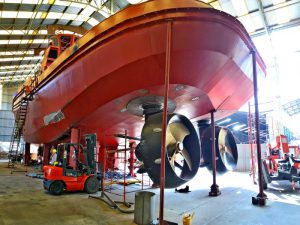
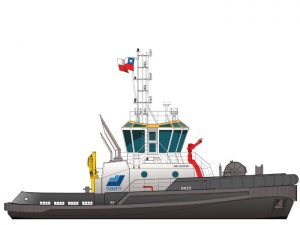
The 24.4 m long x 11.25 m beam RAmparts 2400-W Class tugboat is a twin Z-drive, diesel-powered tug, designed for maximum efficiency in the performance of ship-assist and terminal support operations. The hull form and layout have evolved through the extensive experience of the designers. Ship-handling is performed over the bow using a high-performance, split drum hawser winch.

The tugs will also provide firefighting capability and have up to date accommodations for a crew of six in two single and two double cabins.

The design complies with ABS requirements for the following notations: ✠A1, , ✠ AMS, Towing Vessel, UWILD, Fire-fighting Vessel Class 1 Particulars of the RAmparts 2400-W design are as follows: Length overall

New Argentine-built ASD tug nears delivery

NOVEMBER 11, 2015—Built to an Argentine design in an Argentine yard, a new 28.8m x 10m azimuthing stern drive (ASD) tug will soon be at work handling ships in her home country.

Cat Marine inks milestone LOI with Turkish tug builder

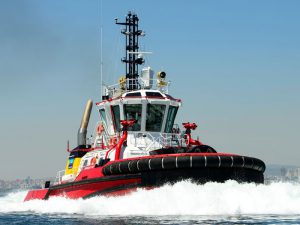
Caterpillar calls the deal “a significant milestone” that “demonstrates Sanmar’s view that Cat power solutions are not only best-in-class today, but are likely to remain so for the foreseeable future.”

The LOI covers the supply of Cat propulsion engines and generator sets to Sanmar for the shipbuilder’s newbuilding program over the coming three years.

At least 84 propulsion engines and 86 generator sets are expected to be supplied between now and 2018. These will include 26 Cat C32, 22 Cat 3512C and 36 Cat 3516C propulsion engines plus 86 Cat C4.4 generator sets.

The engines will primarily power tugboats with bollard pulls of between 60 and 85 tonnes.

Caterpillar has a long relationship with Sanmar.

“The profile of the tugboat sector is changing,” said Cem Seven, Sanmar’s Managing Director. “Consolidation means there are fewer but larger tugboat operators which are increasingly focused on bigger, more powerful vessels to meet the very best standards on sustainability. Demand is shifting to more innovative tugboats which are capable of meeting the designed bollard pull more efficiently. This is what the Cat engines help us to provide to our customers.”

Mark Harrison, Caterpillar Marine Regional Sales Manager, said: “We are delighted to have this seal of approval from one of the industry’s leaders. Our strategy is to focus of designing products to help our customers be successful. For tugs, that is high reliability at increased engine power with quicker acceleration while at the same time providing lower fuel consumption, lower emissions and increased sustainability. Cat marine engines have proven over many years to deliver this to our customers in the tug boat segment.”

Levent Altun, Group Manager at Borusan, Caterpillar’s dealer in Turkey, added: “Even with the latest design features including advanced control and monitoring systems, Cat engines are renowned for ease of operation and straight forward maintenance. Together with the company’s world-wide network providing constant customer support, Cat marine engines and after-sales services are a perfect blend of state-of-the-art technology and sound human relations.”

Sanmar now provides vessels for many of the world’s leading tug operators and recently built and commissioned a second shipyard in Turkey to handle the growing demand.

This year, Sanmar achieved delivery of 25 tugboats to owners from ten different countries, setting a new company record.

Kirby reports third quarter results

Consolidated revenues for the 2015 third quarter were $532.6 million compared with $680.7 million for the 2014 third quarter.

President and CEO David Grzebinski said the results were “largely in line with our expectations.”

“Demand across the majority of the products we carry in the inland marine transportation market remained stable with utilization in the 90% to 95% range,” he said. “Market pressure from inland tank barges shifting out of crude oil service led to continued modest pressure on contract renewal pricing. Spot prices were generally around contract price levels throughout the quarter. In the coastal marine transportation market, pricing for term contract renewals increased modestly. Our results also reflected the anticipated earnings impact from heavy coastal equipment shipyard activity.”

Mr. Grzebinski called market conditions in Kirby’s land-based diesel engine services business, as continuing to be challenging due to the decline in the price of crude oil and, consequently, the low utilization levels of the oilfield service industry pressure pumping fleet.

In the marine diesel engine services and power generation markets, results reflect continuing soft activity in the Gulf of Mexico oilfield service market, but otherwise stable levels of demand.

MARINE TRANSPORTATION

Marine transportation revenues for the 2015 third quarter were $418.3 million compared with $448.7 million for the 2014 third quarter. Operating income for the 2015 third quarter was $93.7 million compared with $112.1 million for the 2014 third quarter.

Kirby’s inland marine transportation business maintained tank barge utilization in the 90% to 95% range.

Demand for inland barge transportation of petrochemicals, refined products and black oil products, excluding crude oil, was consistent with the second quarter. Demand for barges moving crude oil and condensate during the quarter was lower both sequentially and year over year.

Operating conditions were challenging due to scheduled lock closures along the Gulf Intracoastal Waterway and high water conditions during the first part of the third quarter. Delays related to lock outages contributed to a 40% increase in delay days relative to the prior year quarter and a decline in ton miles. In addition to increased delay days, fuel prices, which were down 38% year-over-year, contributed to the year over year decline in revenue.

Demand in the coastal marine transportation market for the transportation of refined petroleum products, black oil, and petrochemicals was relatively stable, although demand for equipment for crude oil transportation declined sequentially and year over year.

Coastal fleet utilization remained in the 90% to 95% range and operating conditions were seasonally normal during the third quarter. A continued heavy shipyard schedule impacted operating results.

The marine transportation segment’s 2015 third quarter operating margin was 22.4% compared with 25.0% for the third quarter of 2014 as a result of higher labor costs, including pension, lower inland marine transportation rates, increased shipyard activity and higher depreciation expense in the coastal business, and the impact of fuel price escalators on inland marine affreightment contracts.

CASH FLOW

Kirby continued to generate strong cash flow during the 2015 first nine months with EBITDA of $437.5 million compared with $484.6 million for the 2014 first nine months. Operating cash flow was used in part to fund capital expenditures of $265.2 million for the 2015 first nine months, including $66.6 million for new inland tank barge and towboat construction, $75.2 million for progress payments on the construction of four new coastal articulated tank barge and tugboat units (“ATBs”), $3.4 million for progress payments on the construction of two 4900 horsepower coastal tugboats, $1.6 million for progress payments on the construction of a new coastal petrochemical barge and $118.4 million primarily for upgrades to existing inland and coastal fleets.

Additionally, Kirby spent $41.3 million to acquire six pressure barges in the first quarter and a total of $202.2 million on share repurchases in the first nine months of 2015.

Total debt as of September 30, 2015 was $810.4 million versus $716.7 million on December 31, 2014, and Kirby’s debt-to-capitalization ratio was 26.4%.

OUTLOOK

Mr. Grzebinski said, “Our earnings guidance range for the 2015 fourth quarter is $0.93 to $1.03 per share and we are revising our full year 2015 guidance range to $4.10 to $4.20 per share [down from the prior guidance of $4.10 to $4.35 per share]. In our inland marine transportation market, our fourth quarter outlook reflects continued modest pricing pressure. Utilization in Kirby’s inland fleet, however, is projected to remain in the 90% to 95% range. In our coastal marine transportation market, although we’ve seen some industry spot availability related to the uncertainty around crude supplies, we expect supply and demand to remain consistent with the first nine months of the year and Kirby’s fleet utilization to remain above 90%. Our guidance assumes normal fourth quarter operating conditions for both the inland and coastal marine transportation markets, including the winter cessation of most operations in Alaska.”

Mr. Grzebinski said demand is expected to remain weak in the land-based diesel engine services market and the offshore oil services portion of the marine diesel engine services market, but is expected to remain relatively stable in the marine and power generation markets.

CAPITAL SPENDING

Kirby expects 2015 capital spending to be in the $320 to $330 million range, an increase of $5 million from earlier capital spending guidance. Contributing to this is a shipbuilding contract entered into the quarter for a 35,000 barrel coastal petrochemical tank barge. The vessel will enter service under contract with an existing customer on delivery, expected in early 2017.

The capital spending guidance range includes approximately $70 million for the construction of 38 inland tank barges and three inland towboats, all expected to be delivered in 2015.The capital spending guidance range also includes approximately $100 million in progress payments on new coastal equipment, including two 185,000 barrel coastal ATBs, two 155,000 barrel coastal ATBs, two 4900 horsepower coastal tugboats and the new coastal petrochemical tank barge.The balance of $150 to $160 million is primarily for capital upgrades and improvements to existing inland and coastal marine equipment and facilities, as well as diesel engine services facilities.
Great Lakes Shipyard holds a double celebration

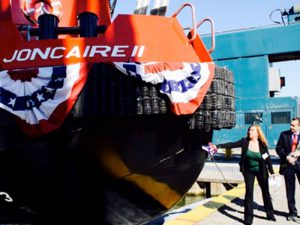
The sponsor of the Commissioning Ceremony was Karen W. Penale, Real Estate Administrator – Western Region, New York Power Authority – Niagara Project.
Breaking the traditional bottle of champagne, she declared “I name this tugboat Joncaire II. May God bless here and all who will sail on her.”

Joncaire II and its sister vessel will be used to service winter operations at the Niagara Power Plant in Buffalo, NY. They will augment and replace aging vessels that are used for the installation, removal, and maintenance of the Lake Erie-Niagara River Ice Boom and for various associated marine construction projects.

Construction for the first tug began last April. The second tug is scheduled for delivery in late-2017.

The new tugs are specially reinforced with heavy stems and shell reinforcement for operations in seasonal ice. The design of the conventional drive tugs includes elevated pilothouses for improved visibility when maneuvering and a spacious work deck aft to facilitate ice boom connections.

In 2010, Great Lakes Shipyard built the New York Power Authority’s new 80′ x 34′ Ice Boom Operations Barge, which incorporates a Terex 80-ton pedestal mounted lattice boom crane.

KEEL LAYING

The tug commissioning was followed by a separate ceremony, marking the keel laying of a new 3,400 H.P. tugboat to be built for Regimen de Pensiones y Jubilaciones del Personal de la Empresa Portuaria Quetzal, Guatemala, Central America. Representing the owner at the ceremony was Eduardo De Jesus Paiz Lemus, Presidente Junta Administrador.

Congresswoman Marcy C. Kaptur, U.S. Representative of the 9th District of Ohio, the principal speaker, commended the Company indicating that “We are fortunate to have a company like Great Lakes – their industry is the gift that keeps on giving. They are [through their education programs] passing on skills to the next generation, who will keep this country great.”

Congresswoman Kaptur also paid compliments to the company’s team – paying special recognition to Ronald C. Rasmus, President of the Great Lakes Group.

She highlighted the significance of the achievement, “To create here, in the heart of America, a shipyard; a place that faces global competition every day, is no small achievement. It is extraordinary. Look at all of the suppliers that benefit from your efforts.”

The tugboat is being built under a contract awarded this August. It will be another of the company’s HandySize Class 3,400 HP twin-screw tugboats and will be used for harbor towing operations in Puerto Quetzal; a growing commercial cargo, container, and cruise port on the Pacific coast of Guatemala.

The buyer, Regimen de Pensiones y Jubilaciones del Personal de la Empresa Portuaria, is a pension benefits plan for port employees and retirees who operate a commercial tugboat service in the port under a Port Authority franchise for the purpose of ensuring future retirement benefits.

Representing the Regimen at the ceremony was Eduardo De Jesus Paiz Lemus, Presidente Junta Administrador, who inscribed his signature on the keel plate declaring that “The keel has been truly and fairly laid.”

The HandySize Class tug was designed by Jensen Naval Architects & Marine Engineers, Seattle, WA.

Set for delivery next year, the tug is specifically designed for harbor work and coastal towing. It is 74-feet long with a beam of 30 feet, and a design draft of 11.5 feet. It is to be built to American Bureau of Shipping (ABS) standards and its Cummins QSK-50 main diesel propulsion engines, each rated at 1700 BHP@ 1600 rpm meet US EPA Tier III emission regulations delivering superior fuel economy, durability, and reliability.

In recognition of the significant achievement for a U.S. domestic shipyard in competitively concluding a foreign sale, the U.S. Department of Commerce’s International Trade Administration and the U.S. Embassy, Guatemala City, was represented at the ceremony by Antonio Prieto, Sr. Trade Specialist, who was credited by the company with facilitating the transparent negotiations and sale.

Navy tug on way to seek El Faro wreckage and VDR

The tug is deploying to a search area northeast of Crooked Island in the Bahamas island chain, which is the last known location of the vessel.

The initial search area is 100 square miles, and water depth is estimated to be 15,000 feet across the expected search area. Transit to this search area is expected to take four-to-five days due to weather.

Apache is equipped with several pieces of underwater search equipment, including a voyage data recorder locator, side-scan sonar and an underwater remote operated vehicle.

The Navy’s mission will be to first locate the ship and then, if possible, to retrieve the voyage data recorder (VDR) – commonly known as a black box.

The U.S. Navy operates some of the world’s most advanced underwater search and salvage systems. Though this equipment is typically used to search for and recover downed military ships and aircraft, the Navy has a long history in assisting other federal agencies in underwater search and salvage operations, including the search and recovery of TWA 800 and the space shuttle Challenger. In 2013, the Navy assisted the government of Australia in its search for missing Malaysian Airliner MH 370.

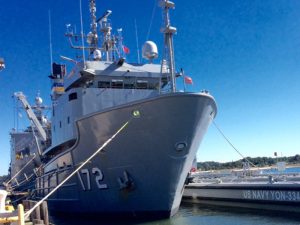
USN Apache is a fleet ocean tug operated by the Military Sealift Command. The ship provides towing, diving and standby submarine rescue services for the Navy.

The ship is 226 feet long and has a crew of approximately 22 civilian mariners and uniformed Navy personnel.
The crew will be joined by a team from the Navy’s Supervisor of Diving and Salvage.

Also on board is the NTSB Investigator-in-Charge, Tom Roth-Roffy, and representatives from the USCG, TOTE and ABS, all parties to the NTSB investigation (see new story).

Harley newbuild will be first with Cat marine Tier 4 engines


When Harley Marine decided to build the new line haul boat, the Earl W. Redd, for towing up and down the U.S. Pacific Coast, the company wanted a proven power platform that would meet the new emissions requirements.

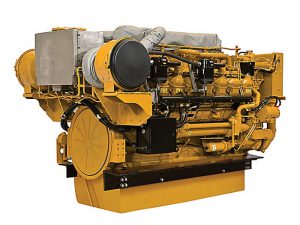
Over the years, Harley Marine has successfully operated line haul tugs powered by Cat 3500 Tier 1 and Tier 2 propulsion engines. Cat dealer Peterson Power suggested two 3516E engines —a flexible power solution that addressed both Harley Marine’s need for power and the upcoming Tier 4 regulations.

To meet the Tier 4 Final emissions standards coming in 2016, each of the two continuous duty 3516E engines—individually rated with a 10% horsepower increase of 2,682 hp at 1,600 rpm—is paired with a selective catalytic reduction (SCR) aftertreatment system, using DEF (diesel exhaust fluid) a urea-based solution, to reduce NOx emissions in the exhaust.

“Harley Marine should save over $1 million across a 15-year lifecycle on total fluid consumption (diesel plus DEF) costs for this newbuild compared to an equivalent Tier 2 powered vessel. They are able to deliver an increased level of performance due to the higher power rating with increased efficiency,” says Ryan Darnell of Caterpillar’s Large Power Systems division. “That’s a direct result of engine fuel efficiency improvements that our SCR technology allows us to make by reducing NOx downstream of the engine combustion process.”

Harley Marine has a long-standing relationship with Caterpillar Marine, including parts and service support from dealers across the United States.  In addition, Cat Financial has provided construction and ownership financing for multiple Harley Marine vessels— including the Earl W. Redd.

“Harley Marine appreciates that they can get the whole package from one source,” says Brent Nelson, a Caterpillar Marine territory sales manager who works closely with Harley Marine. “Caterpillar Marine is able to bring together multiple parties to make sure the design and installation is exactly what they need.”

For this particular vessel, that includes not just Harley Marine, but also Diversified Marine, Peterson Power, the naval architect and Cat engineers back at the factory. Caterpillar says that everything is now on track for the Cat engines to be delivered to the shipyard in April 2016, with vessel construction complete in October of that year.

Harley Marine strengthens management team

“The expansion of our management team reflects the accelerated pace of growth across the organization,” says Harley Marine Services CEO Harley Franco. “Don and Steve represent our ongoing commitment to our customers, employees, and investors to ensure Harley Marine’s recent and projected growth is supported by a team of seasoned executives. We expect to do big things in the coming years and we’re building a world class team to support those activities.”

Prior to joining Harley Marine Services (HMS),Martin (shown at right) was the Vice President and General Counsel formartin Delta Western and Hawaii Petroleum, where he oversaw all aspects of safety, risk management and regulatory compliance for the fuel distribution companies. Previously, he served as the Director of U.S.-flag shipping for ConocoPhillips and held positions with Crowley Maritime Corporation, Exxon Shipping Company, and Olympic Tug & Barge, a subsidiary of HMS. He has a combination of hands-on marine experience including positions from Second Officer through Captain and commercial and legal experience in shore side senior management positions. He attended the University of Washington, California Maritime Academy, and holds a Juris Doctorate degree from the University of the Puget Sound.

Carlson joins HMS from Alaska Marine Lines (AML), where he served as General Manager of Marine Engineering. Prior to joining AML, he was with with Kvichak Marine and the U.S. Coast Guard. Carlson SCarlsonretired from the Coast Guard at the rank of Captain, after 24 years of service, with his last assignment being Chief of the Office of Naval Engineering where he oversaw engineering and logistics support to the entire Coast Guard fleet of over 230 ships and 1,500 boats.  He has advanced degrees in Mechanical Engineering, Marine Engineering and Naval Architecture from the University of Michigan, an executive development program certificate from the University of Washington, and a bachelor’s degree from the U.S. Coast Guard Academy. He is also a licensed Professional Engineer in the State of Washington.
 

USCG icebreaking tug gets life extension makeover

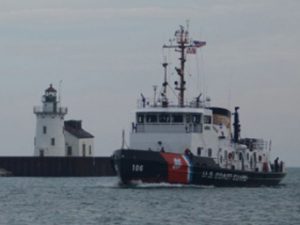
The cutter is one of nine WTGB Bay Class icebreaking tugs built between the late 1970s and early 1980s in Tacoma, WA. Their hulls have an air bubbling system to help them proceed through fresh water ice up to 20 in thick and can break ice up to 3 ft thick by ramming. But after nearly three decades service they are now ready for the SLEP, a major mid-life overhaul expected to extend their service life by 15 years.

Major SLEP work items on the Morro Bay included renewal of the crew’s berthing and mess deck, comprehensive navigation and steering systems upgrades, main propulsion motor overhaul, and installation of a new engine room water-mist fire fighting system and a modern small boat davit system.

The original icebreaking bubbler system, located on the fantail was decommissioned, and a new bubbler system installed in the engine room, where the ship’s service diesel generators had to be moved to accommodate the bubbler system diesel engine and compressor.

The cutter was also sandblasted and painted top to bottom, stem to stern.

With the cutter in the shipyard for theSLEP, Morro Bay’s crew maintained icebreaking proficiency by crew-swapping with the cutter’s sister ship Neah Bay, also homeported in Cleveland, during the 2014-2015 icebreaking season.

LOAD MORE