The contract has been secured through the Ghanaian entity Eidesvik Ghana Limited, which is operated by Ghanaian partners in cooperation with Eidesvik, and Technip.
The firm contract period is 50 days plus mobilization period with an option for charterers to extend the scope of work by a further 50 days. Work is expected to start in the middle of the fourth quarter of this year.
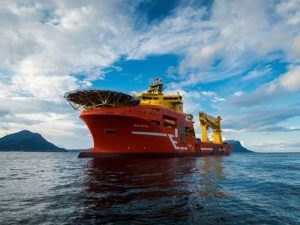
Designed by Salt Ship Design, the 145 m x 31 m OCV has a 400 ton crane and was delivered by shipbuilder Kleven Verft’s Eidesvik, Norway, shipyard in February 2015.
Eidesvik Offshore says the ship “stands out as an excellent base for complex subsea operations” and with the joint crew from Technip and Eidesvik has delivered excellent performance.
“The vessel has been operating for Technip since she was delivered from the yard and we are very pleased to continue the good relation and cooperation between the Technip and Eidesvik teams onboard the vessel and onshore”, says Jan Fredrik Meling, CEO of Eidesvik Offshore ASA. The end-user is Tullow Ghana Limited, the operator and part-owner of the TEN field in Ghana.
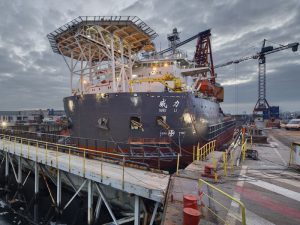
The massive 3,000 tonne lift capacity mounted on the stern and the ship’s unconventional hull form meant that the shipyard had to make special dock bed arrangements to accommodate her.
A total of 225 blocks were required, along with an additional 56 steel pillars of up to 7 m in length to support the stern. Wooden wedges also had to be added to the lateral blocks to take account of the unusual hull shape and to ensure complete stability in the dry dock.
The scope of work over the 10 day period included, along with the standard work for class survey, blasting and painting the hull and the overhauling of the internal and overboard valves. The scope of the electrical works was extensive given the tight time frame, with a large number of motors removed and transported back to the workshop for overhaul before being returned and refitted. The last ones were fitted and tested on the same day of the vessel’s departure.
The starboard propeller blades were also rebuilt. This required re-welding tips onto each of the blades followed by a full polish for both propellers.
Six generator coolers were removed for overhauling, as were their bearings, and some major repairs were made to the accommodations.
Cooperation with the project team from owner Shanghai Salvage was excellent; thanks in part to the assistance of a local Chinese national attending a nearby university who helped smooth the language differences.
“Ensuring that the Wei Li was properly supported in the dry dock was a complex project in itself,” commented Khalil Benjelloul, head of marketing and sales at Damen Shiprepair Dunkerque. “With all the blocks and pillars, plus the positions of the vessel’s thrusters, it was not easy to position her in the centerline of the dock. Once all this was accomplished, however, the work proceeded smoothly and after 10 days of hard work around the clock she was on her way again. It was a pleasure to work with Shanghai Salvage and its representatives.”
The Wei-Li was delivered by shipbuilder Zhenhua Heavy Industries in 2010 and this summer was involved in the installation of the 11,000 tonne jacket for the Ivar Aasen project in the Norwegian sector of the North Sea.
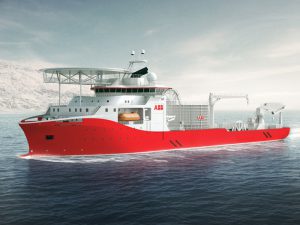
The vessel will be custom built to ABB specifications, with Norway’s Salt Ship Design working closely with ABB, the shipyard and MAATS Tech of the U.K., which is responsible for the integration of the cable lay mission equipment in the design development. The resulting SALT 306 design, says Salt, is “very comprehensive and fit for purpose.”
“This next-generation vessel incorporating state-of-the-art ABB technologies will be a key differentiator for our high-voltage cable business, enhancing flexibility and execution ability,” said Claudio Facchin, president of ABB’s Power Systems division. “It will also improve operational efficiency and customer focus, supporting profitable growth in line with our Next Level strategy.”
The new ship will deploy many of ABB’s own leading marine technologies. The award-winning Onboard DC Grid and power distribution solution, for instance, will use a single DC circuit for ship propulsion to reduce power consumption.
The vessel will set new standards for reliability and accuracy and will be equipped with roll-reduction tanks and the subsea operations will be executed and monitored by a remotely operated vehicle using cameras and sonar, avoiding the need for divers.
The vessel will also feature a complete ABB Integrated Automation System and three Azipod propulsion units. Together with an energy storage system for marine applications it will cut fuel consumption by 27 percent and reduce maintenance compared to traditional AC systems.
Sensors, monitoring hardware and software will enable data to be sent to shore via a satellite link, to allow the onshore technical support centers to work closely with the ship as part of ABB’s Integrated Marine Operations solution. Advanced advisory software for motion monitoring, forecasting and decision support will also be on board.
Thanks to dynamic positioning technology to DP3 class, the ship will be able to maintain its position with a high precision.
It is constructed in such a way that fire and flooding can be contained and will not compromise positioning and other essential systems.
With experience dating back to 1883, ABB is a global leader in high-voltage cable systems with an installed base across applications such as integration of renewables, city center in-feeds, oil and gas platform power supplies, and subsea interconnections. ABB has commissioned more than 25 high-voltage direct current links and hundreds of high-voltage alternating current links around the world.
They will be built by shipbuilder Samsung Heavy Industries, which will deliver them from its Ningbo shipyard in China in 2017 and 2018.
Claus Grønborg, Maersk Tankers VP and head of business development, said the ships “will support our Taking the Lead strategy in the product segment and maintain our strong focus on cost effectiveness. The renewal of our fleet will help us to stay environmentally efficient, competitive and better equipped to meet our customers demands.”
The total order value is approx. MNOK 112, under construction at Daewoo Shipbuilding & Marine Engineering Co, South Korea, for Maersk. TTS has previously delivered similar equipment between 2012 and 2014 for another 20 vessels built at same shipyard for same shipowner.
The winches will be manufactured at TTS’ factory in Korea and deliveries will take place 2016 – 2017.
The less good news comes from subsidiary TTS Offshore Solutions AS in Bergen, Norway. It is to implement temporary workforce reductions with immediate effect.
A workforce of approximate 30 full-time equivalents will be temporary laid off, while another approximate 20 full-time equivalents will be contracted out to other TTS companies.The adjustment affects approximate 40 percent of the workforce of TTS’ offshore operations in Norway and Poland.The adjustments are in response to the current offshore market situation.
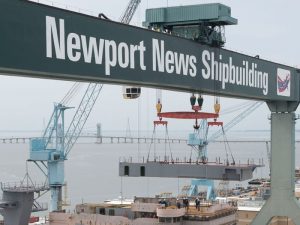
“There’s no good way to do this,” the Virginian-Pilot reports Newport News Shipbuilding President Matt Mulherin as saying, adding that the swiftness of laid-off workers’ departures was largely related to the fact that the shipyard is a secure facility.”
In a “Dear Shibuilders” letter and accompanying FAQ, issued at that time, Mr. Mulherin said “remember that the workload valley has both a beginning and end as our workload increases again in 2017.
“”We will issue 60-day notices to all affected employees,” the workers were told. “Employees will be expected to work during the 60-day notice period.”
However, because the actual number of layoffs was kept below the 500 number, Newport News was not required to give advanced notifications and the workers separated from the company on the day they were laid off.
Seventy seven of those laid off who have the appropriate skills will have the opportunity to return to an hourly trade job.
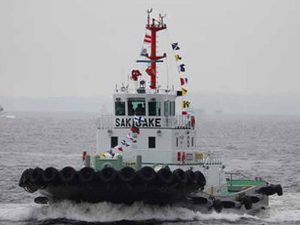
NYK has chartered the tug to Wing Maritime Service Corporation, another wholly owned subsidiary that operates 20 tugboats at the ports of Yokohama, Kawasaki, and Chiba and which will operate the Sakigake mainly in Yokohama and Kawasaki. It is the second environmentally-friendly tugboat to be operated by Wing Maritime which took delivery of the hybrid tug Tsubasa in March 2013.
The Sakigake is equipped with twin Niigata 6L28AHX-DF dual-fuel engines, each developing 1,618 kW. They are the prime movers for a the 360-degree steerable Niigata Z-Peller propulsion system. The DF engines can use either of LNG and diesel oil, depending on conditions. Compared with conventional tugboats that use marine diesel oil, Sakigake emits about 30 percent less carbon dioxide, 80 percent less nitrogen oxide, and absolutely no sulfur oxide when using LNG as fuel.
NYK says that the small size of most tugboats, the limited amount of space, and the large variation in engine power make it difficult to create an LNG fueled tugboat. Keihin Dock was able to achieve the desired level of environmental performance while maintaining the same hull form and steering performance of existing tugboats. To do this, the shipbuilder made full use of its knowledge and technical strengths, and worked closely with both Niigata Power Systems and Air Water Plant & Engineering Inc. to develop equipment for supplying LNG.
LNG will be supplied by Tokyo Gas Co and delivered to the vessel from a tanker truck at a pier in Yokohama, with a successful trial fueling being carried out in July.
The project received subsidies from Japan’s Ministry of Economy, Trade and Industry and the Ministry of Land, Infrastructure and Transport, which support projects promising energy-saving logistics and innovative maritime transport improvements. ClassNK also provided joint research support.
The NYK Group has already ordered the world’s first LNG-fueled car carrier, in addition to an LNG supply vessel, and the group is set to participate in the LNG bunkering business.
Kockums says the A26 has the ability to perform in all oceans and across a broad spectrum of conflict environments. A unique A26 design feature is a Multi Mission Portal for the launch and retrieval of a mix of mission payloads such as manned and unmanned vehicles.
“We have left the design phase behind and begun construction of the A26, a pillar of Sweden’s future naval defence,” says Gunnar Wieslander, head of Saab’s business unit Saab Kockums. “The A26 is a new standard bearer; a step forward in the Swedish tradition of modular design and building, it ensures maximum operational effectiveness with a lower lifecycle cost. With the A26 you can always adapt the submarine to the mission in hand. Now that production has started it is a clear signal to other potential customers around the world that Saab is ready to deliver to them as well.”
The first two A26 submarines are being built under contracts worth a total SEK 7.6 billion placed by the Swedish Defense Material Administration in June this year. The first boat will be delivered in 2022.
The submarines will be powered by conventional diesel-electric propulsion machinery and equipped with the Kockums Stirling AIP (air-independent propulsion) system, making them stealthy and difficult to detect.
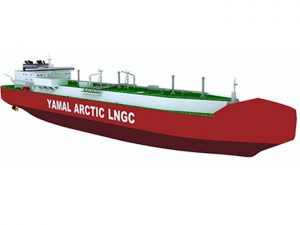
Dynagas will build five 172,000 cu. m ARC 7 LNG carriers at the Daewoo Shipbuilding & Marine Engineering Co., Ltd. shipyard in South Korea. They will serve the Yamal project under long term time charters. The vessels will be capable of breaking 2.1 meter thick ice in both the forward and reverse direction.
In addition, four of Dynagas’ existing ARC 4 LNG carriers will come into the Yamal shipping fleet to support Yamal deliveries committed to Asian buyers from year 2019 onwards and will be time chartered for a period of 15 years each.Yamal LNG is a joint venture between NOVATEK (60 percent), TOTAL (20 percent) and China National Oil & Gas Exploration and Development Corporation (CNODC) (20 percent). The project consists of three LNG trains with a total capacity of approximately 16.5 million metric tons of LNG per annum.
“The award of five long term contracts for the ARC 7 LNG carriers and award of four long term contracts for our existing ARC4 LNG carriers is a testament to our long term commitment and our manager’s operational excellence and expertise in operating high specification ice class LNG carriers,” commented Mr. George Procopiou, founder and chairman of Dynagas.
Dynagas Holding Ltd is a holding company engaged in the ownership of LNG carriers and owner of 44% of the equity interests in Dynagas LNG Partners LP (NYSE: DLNG), including the General Partner interest.
The unit was ordered during the second quarter of 2012 and the delivery date stated in the construction contract was by December 31, 2014.
“Due to the shipyard’s inability to deliver the unit within the timeframe required under the contract, the company has exercised its cancelation rights,” says Seadrill, which notes that, under the contract terms, it has the ability to recoup its $168 million in pre-delivery installments to the shipyard, plus accrued interest.
In fourth quarter 2012, Seadrill was awarded a five year contract for the West Mira with Husky Oil Operations for operations in Canada and Greenland.
In its second quarter earnings report, Seadrill reported that, due to the late delivery of West Mira, the company had tentatively agreed with Husky to reduce the dayrate of the West Mira drilling contract.
Seadrill says it remains in discussions with Husky to find an alternative solution to meet its drilling requirements.
 The starboard propeller blades were also rebuilt. This required re-welding tips onto each of the blades followed by a full polish for both propellers.