“By building these ships we enter a market niche that will enable sustainable business operation, bigger engagement of capacities and acquisition of references for the building of ships that will be in higher demand in the near future,” says Tomislav Debeljak, CEO of Brodosplit and owner of Brodosplit Shipping Company.
“DNV GL experts were involved from the design phase and worked very closely with Brodosplit to realize this project. We are very pleased with the cooperation and look forward to continuing our work together in the future,” says Ivo Siljic, Senior Lead Surveyor at DNV GL – Maritime.
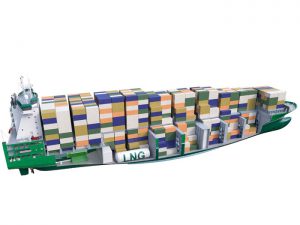
With an individual deadweight of 24,000 dwt, the vessels will be over 184 meters long and 27.5 meters wide. They will have a capacity of 2,000 TEUand reach speeds of up to 18 knots.
The containerships feature two-stroke dual fuel (LNG/MGO) engines built under license from MAN by Brodosplit’s diesel engine factory, which will also build the ships’ LNG tanks.
It reported today that it has been notified that Petrobras Transportes S.A. (Transpetro) has terminated the contracts for two liquefied petroleum gas (LPG) carriers on order at 50.5% owned indirect subsidiary Vard Promar.
The vessels in question are the last two of a series of eight LPG carriers originally contracted at the Brazilian shipyard in June 2010, for delivery from Vard Promar between 2014 and 2016. The combined contract value for the series of eight vessels was $536 million.
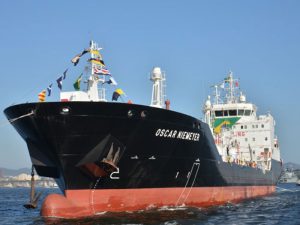
The first of the eight vessels, the 8,000 cu.m Oscar Niemayer, was delivered this past July.
Singapore listed Vard, which is 55.63% controlled by Fincantieri, says that the construction of the two vessels that have now been canceled is “at a very early stage.”
Vard is currently reviewing its overall exposure to the Brazilian market, and it says that the termination of the contracts – if effective – is “expected to reduce the company’s overall exposure. At the same time, the company intends to claim compensation from Transpetro for damages in relation to the terminated contracts.”
Vard says the impact of the termination is not expected to have a material effect on the earnings per share of the Group for the financial year ending December 31, 2015.
They will be used to combat illegal activities such as terrorism and smuggling in Moroccan waters.
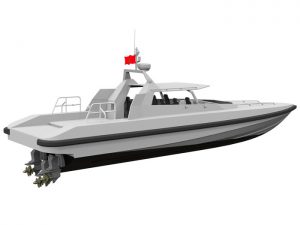
Designed for ultra-fast operations, the Interceptor 1503 can reach speeds of up to 60 knots, thanks to combining an outstanding propulsion system —powered by three MDS (Marine Diesel Sweden) VG-32 diesels — with cutting edge lightweight composite materials.
Each diesel drives a separate stern drive. The hull is constructed from fiber reinforced plastic in an epoxy resin matrix – renowned for its resistance to impact and fatigue as well as its lightweight properties.
Well suited for tracking down and taking appropriate action on illegal activities, the highly maneuverable Interceptors also have additional space in the cockpit for search and rescue survivors.
As international security concerns have heightened, Damen has seen growing interest in its range of Interceptor vessels. In response, it is continuing to invest in a substantial Research and Development program to design and build safe, strong and ultra-fast composite vessels.
Although the Interceptor has been in Damen’s portfolio for some time, the five vessels in this latest ordervwill be the first in a new series of reengineered vessels.
All five Interceptor 1503 vessels will be constructed at Damen’s state-of-the-art shipyard specializing in composite vessel construction in Antalaya, Turkey.
The first vessel will be delivered in June 2016, followed thereafter by one vessel every six weeks
DECEMBER 14, 2014 — Helgoland, Germany’s first newbuild LNG fueled seagoing vessel was christened and made its maiden voyage December 11. Built by the Fr. Fassmer shipyard, the 83 m x 12.6
SEA-Vista is a partnership between SEACOR Holdings Inc. and private equity firm Avista Capital Partners. Its ships will be operated by SEACOR subsidiary Seabulk Tankers, Inc.
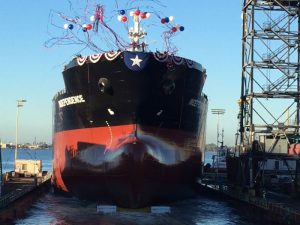
The Independence is a 610-foot, 50,000 deadweight-ton, and LNG-conversion-ready Jones Act product tanker with a 330,000 barrel cargo capacity. Construction on the ship began in November 2014.
As part of the ceremony, the ship’s sponsor, Mrs. Allison Moran, CEO of RaceTrac Petroleum, christened the ship with a traditional champagne bottle break over the ship’s hull. Mrs. Jayne Rathburn, former CEO/owner of US Joiner, pulled the trigger to release the ship into the San Diego Bay.
“General Dynamics NASSCO shipbuilders are revolutionizing the future of American shipping with the concept and construction of innovative, cost-saving, and environmentally-sound vessels,” said Kevin Graney, vice president and general manager for General Dynamics NASSCO. “When delivered, these ECO Class, Jones Act-qualified tankers will be among the most fuel-efficient and environmentally-friendly tankers anywhere in the world.”
“We are pleased to complete this important milestone for the first in a series of three fuel-efficient, ECO Jones Act product tankers that will be delivering into the SEA-Vista fleet and operated by Seabulk Tankers, Inc,” said Daniel J. Thorogood, president and chief operating officer for Seabulk Tankers, Inc.
For its commercial work, NASSCO partners with South Korea’s Daewoo Shipbuilding & Marine Engineering (DSME), for access to state-of-the-art ship design and shipbuilding technologies.
With more than 20 years of engineering and maritime experience, Mr. McGee will oversee vessel design from preliminary conceptual design to complete Coast Guard and regulatory approvals.
Chesapeake Shipbuilding currently has on staff five naval architects and two engineers.
“McGee’s experience in various positions with the U.S. Coast Guard, including Hull Division Chief at the Marine Safety Center and former Officer in Charge, Marine Inspection, is a valuable asset we look forward to having on our team,” said Charles A. Robertson, President and CEO. “His rock solid reputation in the maritime industry will be critical for the retention and expansion of our customer base.”
Mr. McGee holds a bachelor’s degree in naval architecture and marine engineering from the U.S. Coast Guard Academy and a master’s of science in both naval architecture and marine engineering as well as aerospace engineering from the University of Michigan.
Chesapeake Shipbuilding designs and builds steel and aluminum commercial vessels primarily between 100 and 400 feet. The shipyard has upgraded its production capacity significantly in recent years, by acquiring additional land, building two new hull fabrication buildings and investing in additional automated equipment.
“Brent has been a key contributor to Bollinger’s success in leading our proposal and estimating efforts on the major governments programs the company has pursued over the years,” said President and CEO Ben Bordelon.
“His leadership and management skills will assist in guiding the continuous success of our engineering department.”Mr. Blackburn has over 16 years of experience in the U.S. shipbuilding and maritime industry. He joined Bollinger in 2004 working in various key engineering, estimating, and proposal roles mainly focusing on the company’s government programs.
Mr. Blackburn’s career began as a Project Engineer in Bollinger’s engineering group and he has risen steadily through the engineering and technical design departments. In 2014, he was promoted to Technical Manager, a position that solidified and proved his abilities, skills, and overall knowledge in managing projects and priorities.
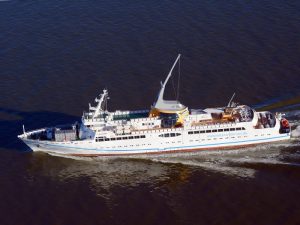
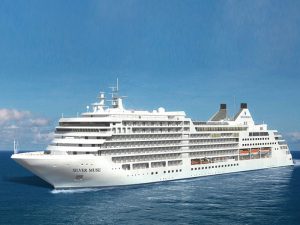
At 40,700 gt and accommodating 596 passengers in all-suite accommodations, Silver Muse will be an evolution of the 36,000 gt, 540 passenger Silver Spirit, delivered in 2009 by Fincantieri’s Ancona shipyard.
The delivery of the ship is scheduled for spring 2017.
Yesterday’s keel laying ceremony included the tradition of welding a coin into the keel of the ship, though Silversea took things a step further by welding eight coins into the keel of Silver Muse.
Each coin represents one of the seven continents that Silversea ships sail to, along with a specially designed commemorative Silver Muse coin. The coins are:
A South African rand
An Australian dollar
A U.S. half dollar
A Brazilian real
An Italian euro
A Singapore dollar
A commemorative Antarctica trust coin
A specially designed Silversea Silver Muse commemorative coin
The ceremony was attended by Silversea CEO Enzo Visone and Fincantieri shipyard director Raffaele Davassi.
“Today marks a significant milestone for Silversea with the birth of our newest ship,” said Mr. Visone. “We proudly sail to all seven continents, discovering new destinations and ports with our intimate, boutique vessels, and we are now one step closer to introducing Silver Muse to the fleet.
“With an unprecedented variety of dining options and a design across the ship that encourages open-air cruising, guests will be able to enjoy magnificent destinations as never before. Silversea looks forward to working closely with Fincantieri throughout the construction phase of Silver Muse and in the run-up to her launch in spring 2017.”
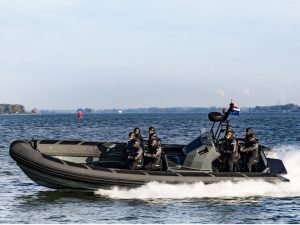
The RHIB 1050 was developed at Damen Shipyards Hardinxveld, a long time RHIB supplier to the Royal Netherlands Navy.
“This is not your average RHIB,” says Roel Foolen, the shipyard’s Newbuild Project Manager. “For starters, it’s Lloyds approved. The hull is made of glass reinforced epoxy as opposed to polyester and provided with Lloyd’s approved closed cell, foam core.”
“Further to this, we are also able to provide training in its use,” adds Mr. Foolen. “Damen has many years’ experience in building boats for navies and other defence and security bodies.”
Damen’s use of epoxy for the hull will see the RHIB 1050 produced at the group’s specialist composites yard in Antalya, Turkey.
The RHIB will be produced in series with a standard hull, open to flexible, client-specified outfitting requirements.
Ergonomics are a strong theme running throughout the design. Damen developed the layout using a mock-up console, constantly tweaking the positioning of instrumentation, seating and controls until completely satisfied with comfort levels. Consequently, the wheel and throttle are perfectly aligned with the suspension seating and handles and grips are located strategically throughout the RHIB.
“We’ve aimed to cover every detail – for example including steps to facilitate easy, fast exit of the RHIB in boarding ops and integration of hoisting eyes into the bollards, simultaneously removing a trip hazard and taking advantage of every available bit of space,” says Mr. Foolen.
The RHIB uses D-shaped tubing, rather than the conventional cylindrical tubing.
“Doing this allows us to combine the console and the engines into a single, space saving unit,” says Mr. Foolen.” Usually this would not be possible as such a unit would impede access to the fore of the vessel. However, with a section of tubing removed, there is still space for on board personnel to pass safely and comfortably fore to aft.”
The vessel is easy to maintain. For example, its two 350 liter fuel tanks are located beneath the ten deck-based seats which are fitted to a dedicated hatch so that, in the event the tanks require removing, the seating is simply lifted clear.
Similarly, the entire console unit is hinged at the aft so that it can be very easily moved clear when access is necessary to the RHIB’s two 370 hp Volvo Penta engines. The mast is also hinged so that it can be quickly folded away for transport height.
“As well as easy maintenance, the RHIB 1050 is also low maintenance,” says Mr Foolen. “We’ve used high-end materials and taken every step to ensure components are protected. Console instrumentation is located behind a heated, watertight window for example. And all electrics are housed in a dedicated, heated and ventilated compartment inside the dry storage area.”
The stern platform, as well as being ideally situated for diving and man overboard operations, works in combination with the tube ends to form a protective barrier for the stern drives.
At the front of the vessel, the nose is flattened to serve as a fender during boarding operations and the tubing is fitted to the vessel with aluminum extrusions, not glue. This not only offers a better grip, but also makes it easier to remove and replace when necessary.
How about performance?
“During seatrials, the handling, maneuverability and balance have proven to be excellent,” says Mr. Foolen. “It’s very safe also, very forgiving and perfect in rough, harsh water. She’s quick too – able to sail at speeds of over 50 knots.”
Damen is currently building a second RHIB 1050, which will feature two 400 hp outboard engines.
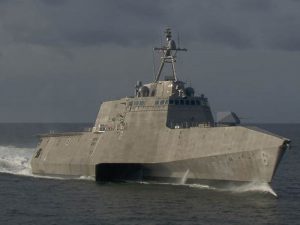
In a stock exchange announcement, the company noted that in its FY2015 results it had reported experiencing schedule and margin pressure on Littoral Combat Ship (LCS) 6, the first that it is building as the prime contractor.
“Austal is building multiple LCS in parallel,” said the announcement, “with the impact of cost and schedule performance on LCS 6 continuing to impact LCS 8 and LCS 10 – both of which are in an advanced state of completion.
“Austal’s ability to apply lessons learnt and productivity enhancements from LCS 6 to vessels in advanced construction, namely LCS 8 and LCS 10, has been more limited than anticipated. As a result, FY2016 earnings from Austal’s U.S. shipyard are expected to be lower than in FY2015, with U.S. shipbuilding EBIT margin expected to be in the range of 4.5% to 6.5%. [Its U.S, shipbuilding EBIT margin was 5.2% in 2015 and 6.6% in 2014]
“Austal’s other major vessel program at its U.S. shipyard, the Expeditionary Fast Transport program (formerly called the Joint High Speed Vessel), has reached construction program maturity, with shipbuilding margin stable”.
Austal CEO Andrew Bellamy said that, while there were flow on effects from LCS 6 onto LCS 8 and 10, vessels at earlier stages of construction would benefit from the lessons learnt on LCS 6 to increase future US shipbuilding margin.
“The LCS program is maturing more slowly than we had expected, however we are working hard to manage the risks and expect an improvement across the program after delivery of LCS 10,” Mr. Bellamy said. “The ongoing strong performance of the US$1.6 billion Expeditionary Fast Transport program at our U.S. shipyard is a great illustration of the efficiencies we can deliver once a vessel program reaches the mature production phase and we are confident the LCS program will be no different.
“Austal has a strong balance sheet and is generating good cash flow, which is enabling further investment in the business during the 2016 financial year to best position the company to win additional contracts and service work to build our order book, revenue, and earnings into the future.”