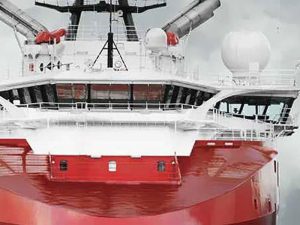
The vessel, now named Skandi Responder, is a VARD 1 08 design platform supply vessel. According to Vard it is the first of two vessels whose original shipbuilding contracts were terminated earlier this year. It has now been delivered from the Vard Vung Tau shipyard in Vietnam and sold to Vard Shipholding Singapore Pte. Ltd., a newly established wholly-owned subsidiary of Vard Holdings.
Vard says that it continues to explore opportunities for a sale of the vessel. The second PSV whose contract was terminated is still under construction at Vard Vung Tau, with an expected completion date in second quarter 2016.
Vard CEO and Executive Director Roy Reite commented, “I am delighted that together with our long-term client DOF, we have found a solution that secures employment for this vessel following completion at the yard in Vung Tau. Securing this charter in today’s difficult market is proof of the attractiveness of Vard-built vessels for some of the most demanding jobs in the offshore industry, and I am confident that successfully operating it in Australia will increase our chances for a sale.”
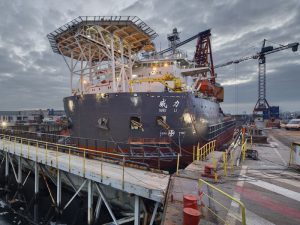
The massive 3,000 tonne lift capacity mounted on the stern and the ship’s unconventional hull form meant that the shipyard had to make special dock bed arrangements to accommodate her.
A total of 225 blocks were required, along with an additional 56 steel pillars of up to 7 m in length to support the stern. Wooden wedges also had to be added to the lateral blocks to take account of the unusual hull shape and to ensure complete stability in the dry dock.
The scope of work over the 10 day period included, along with the standard work for class survey, blasting and painting the hull and the overhauling of the internal and overboard valves. The scope of the electrical works was extensive given the tight time frame, with a large number of motors removed and transported back to the workshop for overhaul before being returned and refitted. The last ones were fitted and tested on the same day of the vessel’s departure.
The starboard propeller blades were also rebuilt. This required re-welding tips onto each of the blades followed by a full polish for both propellers.
Six generator coolers were removed for overhauling, as were their bearings, and some major repairs were made to the accommodations.
Cooperation with the project team from owner Shanghai Salvage was excellent; thanks in part to the assistance of a local Chinese national attending a nearby university who helped smooth the language differences.
“Ensuring that the Wei Li was properly supported in the dry dock was a complex project in itself,” commented Khalil Benjelloul, head of marketing and sales at Damen Shiprepair Dunkerque. “With all the blocks and pillars, plus the positions of the vessel’s thrusters, it was not easy to position her in the centerline of the dock. Once all this was accomplished, however, the work proceeded smoothly and after 10 days of hard work around the clock she was on her way again. It was a pleasure to work with Shanghai Salvage and its representatives.”
The Wei-Li was delivered by shipbuilder Zhenhua Heavy Industries in 2010 and this summer was involved in the installation of the 11,000 tonne jacket for the Ivar Aasen project in the Norwegian sector of the North Sea.
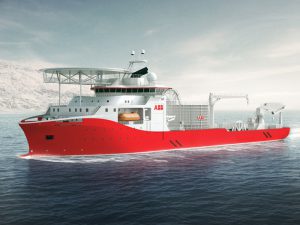
The vessel will be custom built to ABB specifications, with Norway’s Salt Ship Design working closely with ABB, the shipyard and MAATS Tech of the U.K., which is responsible for the integration of the cable lay mission equipment in the design development. The resulting SALT 306 design, says Salt, is “very comprehensive and fit for purpose.”
“This next-generation vessel incorporating state-of-the-art ABB technologies will be a key differentiator for our high-voltage cable business, enhancing flexibility and execution ability,” said Claudio Facchin, president of ABB’s Power Systems division. “It will also improve operational efficiency and customer focus, supporting profitable growth in line with our Next Level strategy.”
The new ship will deploy many of ABB’s own leading marine technologies. The award-winning Onboard DC Grid and power distribution solution, for instance, will use a single DC circuit for ship propulsion to reduce power consumption.
The vessel will set new standards for reliability and accuracy and will be equipped with roll-reduction tanks and the subsea operations will be executed and monitored by a remotely operated vehicle using cameras and sonar, avoiding the need for divers.
The vessel will also feature a complete ABB Integrated Automation System and three Azipod propulsion units. Together with an energy storage system for marine applications it will cut fuel consumption by 27 percent and reduce maintenance compared to traditional AC systems.
Sensors, monitoring hardware and software will enable data to be sent to shore via a satellite link, to allow the onshore technical support centers to work closely with the ship as part of ABB’s Integrated Marine Operations solution. Advanced advisory software for motion monitoring, forecasting and decision support will also be on board.
Thanks to dynamic positioning technology to DP3 class, the ship will be able to maintain its position with a high precision.
It is constructed in such a way that fire and flooding can be contained and will not compromise positioning and other essential systems.
With experience dating back to 1883, ABB is a global leader in high-voltage cable systems with an installed base across applications such as integration of renewables, city center in-feeds, oil and gas platform power supplies, and subsea interconnections. ABB has commissioned more than 25 high-voltage direct current links and hundreds of high-voltage alternating current links around the world.
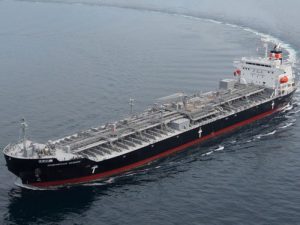
They will be built by shipbuilder Samsung Heavy Industries, which will deliver them from its Ningbo shipyard in China in 2017 and 2018.
Claus Grønborg, Maersk Tankers VP and head of business development, said the ships “will support our Taking the Lead strategy in the product segment and maintain our strong focus on cost effectiveness. The renewal of our fleet will help us to stay environmentally efficient, competitive and better equipped to meet our customers demands.”
Mitsubishi Heavy Industries Marine Machinery & Engine Co (MHI-MME) has been developing the 500 mm bore, 2,300 mm two stroke as a state-of-the-art engine incorporating cutting-edge technology to meet market needs that including reduced fuel consumption, slow steaming, low engine-load capabilities and compliance with emission regulations.
The 6UEC50LSH-Eco-C2 in Chemroad Queen was built by licensee Kobe Diesel and was delivered to the shipbuilder, Shin Kurushima Dockyard, in March after completing shop testing, onboard testing was completed last month and the ship, owned by Iino Kaiun Kaisha, went into service without any complications.
Design of the UEC50LSH-Eco engine began with thorough market research and engine power output and speed were adjusted to those suitable for chemical tankers, handymax bulk carriers, supramax bulk carries and medium range tankers.
MHI-MME has now received follow up orders for M/E 5UEC50LSH-Eco-C2 main engines for 38,000 dwt chemical tankers to be built at Kitanihon Shipbuilding and says that many inquiries are also being received.
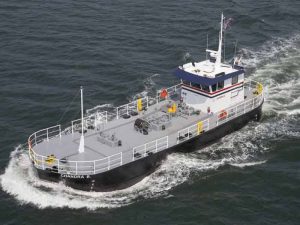
The Chandra B is named after one of owner Stephen Bragoli’s daughters and, as we reported earlier, was launched from the shipbuilder’s newly refurbished production hall using its lift dock.
Designed by Farrell & Norton Architects, the vessel has been built to USCG Subchapter D specifications and will operate in New York Harbor and New Jersey.
Main propulsion power is provided by twin Tier III Cummins Model QSL9, six-cylinder diesel engines. Each is rated at 330 hp at 1,800 rpm and each drives a 48 inch diameter, 54 inch pitch, four bladed propeller from HS Marine Propulsion viah ZF Model W325 marine hydraulic gears with a 4.91:1 reduction ratio The vessel is also equipped with a 50 hp Wesmar hydraulic bow thruster.
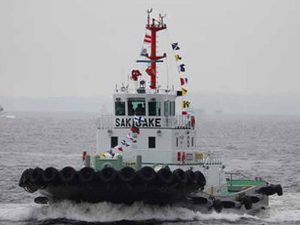
NYK has chartered the tug to Wing Maritime Service Corporation, another wholly owned subsidiary that operates 20 tugboats at the ports of Yokohama, Kawasaki, and Chiba and which will operate the Sakigake mainly in Yokohama and Kawasaki. It is the second environmentally-friendly tugboat to be operated by Wing Maritime which took delivery of the hybrid tug Tsubasa in March 2013.
The Sakigake is equipped with twin Niigata 6L28AHX-DF dual-fuel engines, each developing 1,618 kW. They are the prime movers for a the 360-degree steerable Niigata Z-Peller propulsion system. The DF engines can use either of LNG and diesel oil, depending on conditions. Compared with conventional tugboats that use marine diesel oil, Sakigake emits about 30 percent less carbon dioxide, 80 percent less nitrogen oxide, and absolutely no sulfur oxide when using LNG as fuel.
NYK says that the small size of most tugboats, the limited amount of space, and the large variation in engine power make it difficult to create an LNG fueled tugboat. Keihin Dock was able to achieve the desired level of environmental performance while maintaining the same hull form and steering performance of existing tugboats. To do this, the shipbuilder made full use of its knowledge and technical strengths, and worked closely with both Niigata Power Systems and Air Water Plant & Engineering Inc. to develop equipment for supplying LNG.
LNG will be supplied by Tokyo Gas Co and delivered to the vessel from a tanker truck at a pier in Yokohama, with a successful trial fueling being carried out in July.
The project received subsidies from Japan’s Ministry of Economy, Trade and Industry and the Ministry of Land, Infrastructure and Transport, which support projects promising energy-saving logistics and innovative maritime transport improvements. ClassNK also provided joint research support.
The NYK Group has already ordered the world’s first LNG-fueled car carrier, in addition to an LNG supply vessel, and the group is set to participate in the LNG bunkering business.
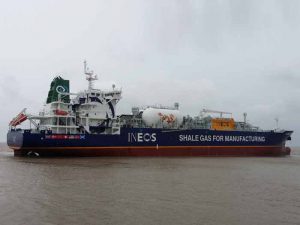
The Dragon vessels were originally designed as dual-fuel LNG/diesel powered vessels, with two 1,000 cu m LNG tanks on deck powering two Wärtsilä 6L20 DF main engines with a total output of 2,112 kW and two shaft generators with a total output of 3,600 kW power. As we reported in May (see earlier story), as the vessels will initially transport ethane from the U.S, to the U.K. Ineos refineries, the ability to also burn ethane was added to allow use of the cargo gas as fuel.
“The ability to burn ethane as well as LNG to power these unique vessels is a major step forward in the use of clean fuels. It means the vessels can use cargo gas during transits to provide a clean and clear commercial and environmental advantage,” says Bureau Veritas Business Development Manager Martial Claudepierre. “We have worked with Evergas and the Danish Maritime Authority to verify and ensure that the use of ethane is at least as safe as required by the IGC and will not impair the engine compliance with MARPOL Annex VI.”
According to Mr. Claudepierre, using ethane required extra engine room ventilation and additional gas detection, plus modifications to the main engines including a lower compression ratio, different turbocharger nozzles and de-rating of the engine to cope with the lower knocking resistance of ethane. “But,” he says, “the gains in not carrying an additional fuel and in environmental performance from being able to burn clean fuel throughout the voyage are significant.”
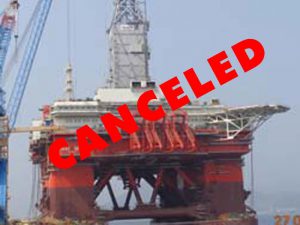
The unit was ordered during the second quarter of 2012 and the delivery date stated in the construction contract was by December 31, 2014.
“Due to the shipyard’s inability to deliver the unit within the timeframe required under the contract, the company has exercised its cancelation rights,” says Seadrill, which notes that, under the contract terms, it has the ability to recoup its $168 million in pre-delivery installments to the shipyard, plus accrued interest.
In fourth quarter 2012, Seadrill was awarded a five year contract for the West Mira with Husky Oil Operations for operations in Canada and Greenland.
In its second quarter earnings report, Seadrill reported that, due to the late delivery of West Mira, the company had tentatively agreed with Husky to reduce the dayrate of the West Mira drilling contract.
Seadrill says it remains in discussions with Husky to find an alternative solution to meet its drilling requirements.
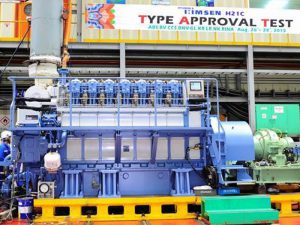
The HiMSEN engine has just passed another milestone. The next generation CLEAN (Customer, Liability, Environment, Acceptable Technology, No Defect) HiMSEN engine has now completed type approval testing in the presence of eight major classification societies including ABS, DNV/GL, LR and KR.
The four-stroke CLEAN HiMSEN engine (Model H21C) improves power output by 20 percent and fuel efficiency up to 2 percent compared to the existing same class four-stroke engines, H21/32, while physical size and weight are 10 percent lower, thanks to the utilization of high pressure combustion technology.
The IMO Tier III-compliant engine emits 98 percent less NOx with the use of HHI’s proprietary Hyundai Selective Catalytic Reduction technology, NoNOx.
Mr. Youn Joong-geun, executive vice president of HHI’s Engine & Machinery Division said, “Our next-generation CLEAN HiMSEN engine is the culmination of our 40 years of technological know-hows and experiences. With the customer-oriented engineering, the high-output and high-efficiency engine will surely bring mutual benefits to HHI and its valued customers.”
 The starboard propeller blades were also rebuilt. This required re-welding tips onto each of the blades followed by a full polish for both propellers.