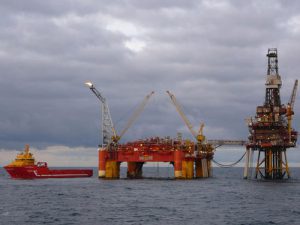
Eidesvik also announced that Statoil has entered into an agreement for installation of an Energy Storage System (battery solution) onboard the vessel.
The Viking Energy was the first LNG fueled PSV in the world when it was delivered in 2003, and has been on contract for Statoil since delivery. It will not, though, be the first Eidesvik vessel be retrofitted with a battery solution.
Back in May, Eidesvik announced an agreement with Lundin Norway AS for installation of an Energy Storage System (battery solution) onboard the vessel Viking Queen.
Eidesvik said that the retrofit agreement was possible through a targeted cooperation between itself and Lundin Norway AS. which has the vessel on hire, and lithium ion battery specialist ZEM AS, as supplier of the system.
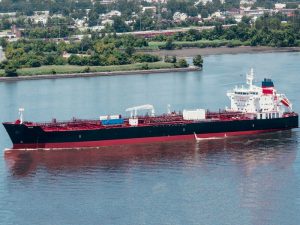
The LNG-Ready Level 1 approval was issued, along with an approval in principle for the first vessel in a series built by Aker Philadelphia Shipyard and operated by Crowley Maritime Corporation, the recently delivered Ohio.
By achieving compliance with the ABS Guide for LNG Fuel Ready Vessels, Crowley has the option to convert the product tankers in the series to LNG fueled propulsion at a later date having already been granted a conceptual review.
“ABS has played a fundamental role in supporting the ambitions of the maritime industry as it moves to embrace the opportunity of LNG as fuel,” says ABS Chairman, President and CEO Christopher J. Wiernicki. “This milestone builds upon our work to provide owners with the guidance and support they need to move ahead with shipbuilding projects that allow them the flexibility to respond to changes over the lifetime of their vessels.”
ABS published the Guide for LNG Fuel Ready Vessels in 2014. The LNG-Ready endorsements allow shipowners and yards the flexibility to limit their initial investment while planning for the future conversion to dual fuel or gas-powered combustion engines. A well-thought-out plan can prepare shipowners to face ever-increasing stricter environmental regulations as well as help save time and money by considering basic gas-fueled ship requirements during the preliminary design and minimizing the potential changes during the future conversion.
“Crowley is proud to be the first company to actually receive this designation from ABS,” says Rob Grune, SVP and general manager petroleum services for Crowley. “As our business continues to shape itself to better meet the requirements of our customers, these vessels that stand ready and able to operate on a cleaner, alternative fuel source are our way of anticipating future demands.”
“Working with ABS and Crowley to build the first LNG-Ready product tanker has been a valuable process and has allowed the shipyard to deliver a vessel with the flexibility to evolve in the future” says Scott Clapham, SVP of Aker Philadelphia Shipyard.
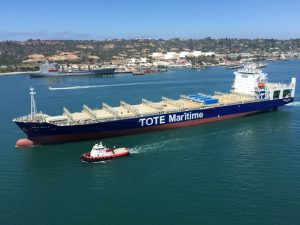
With the tragic loss of the TOTE ship El Faro still weighing heavily on the whole American maritime community, the delivery was not greeted with the celebrations that would normally mark an achievement of this magnitude.
The ship is the first delivered under a two-ship contract signed in December 2012 with TOTE. The two 764-foot long Marlin Class containerships will be the largest dry cargo ships fueled by LNG.
“Successfully building and delivering the world’s first LNG-powered containership here in the United States for coastwise service demonstrates that commercial shipbuilders, and owners and operators, are leading the world in the introduction of cutting-edge, green technology in support of the Jones Act,” said Kevin Graney, vice president and general manager of General Dynamics NASSCO.
The shipbuilder says the delivery is the result of a successful collaboration between industry and regulatory bodies. TOTE, NASSCO, the American Bureau of Shipping, and the U.S. Coast Guard worked hand-in-hand from the beginning of the project to the delivery of the Isla Bella. This included collaboration during the design approval, construction and commissioning the ship to safely and effectively operate on natural gas.
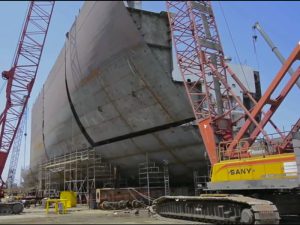
First steel for the ship was cut in October 2014 and it is now 25 percent complete.
“Week by week, we have watched the pair of Commitment Class ships begin to take shape,” said John Hourihan, senior vice president and general manager, Puerto Rico/Caribbean liner services. “It’s been incredible to watch. Once fully constructed, these new vessels will embody superior technology and construction and, while we are anxious to get them into service for our partners in Puerto Rico, we are thrilled that they are coming together on schedule.”
“The entire team at VT Halter Marine is pleased and proud to be partnered with Crowley in the construction of these magnificent ships,” said VT Halter Marine President and CEO Jack Prendergast. “It is a pleasure to see the hard work of the Crowley/Halter team come to fruition.”
The ships will be 219.5 meters long, 32.3 meters wide (beam), have a deep draft of 10 meters, and an approximate deadweight capacity of 26,500 metric tons.Cargo capacity will be approximately 2,400 TEUs (20-foot-equivalent-units), with additional space for nearly 400 vehicles in an enclosed Roll-on/Roll-off garage.
Each ship will be powered by an MAN B&W 8S70ME-GI8.2 main engine and three MAN 9L28/32DF auxiliary engines fueled by LNG.
The ship design is provided by Wärtsilä Ship Design in conjunction with Crowley subsidiary Jensen Maritime, a leading Seattle-based naval architecture and marine engineering firm.
The Commitment Class, Jones Act ships will replace Crowley’s towed triple-deck barge fleet, which has served the trade continuously and with distinction since the early 1970s. These new ships will offer customers fast ocean transit times, while accommodating the company’s diverse equipment selection and cargo handling flexibility. El Coquí and Taíno are scheduled for delivery second and fourth quarter 2017 respectively.
Designing, building and operating LNG-powered vessels is in line with Crowley’s overall EcoStewardship positioning and growth strategy. The company formed an LNG services group earlier this year to bring together the company’s extensive resources to provide LNG vessel design and construction management; transportation; product sales and distribution, and full-scale, project management solutions.
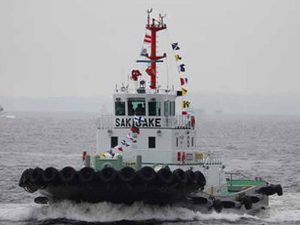
NYK has chartered the tug to Wing Maritime Service Corporation, another wholly owned subsidiary that operates 20 tugboats at the ports of Yokohama, Kawasaki, and Chiba and which will operate the Sakigake mainly in Yokohama and Kawasaki. It is the second environmentally-friendly tugboat to be operated by Wing Maritime which took delivery of the hybrid tug Tsubasa in March 2013.
The Sakigake is equipped with twin Niigata 6L28AHX-DF dual-fuel engines, each developing 1,618 kW. They are the prime movers for a the 360-degree steerable Niigata Z-Peller propulsion system. The DF engines can use either of LNG and diesel oil, depending on conditions. Compared with conventional tugboats that use marine diesel oil, Sakigake emits about 30 percent less carbon dioxide, 80 percent less nitrogen oxide, and absolutely no sulfur oxide when using LNG as fuel.
NYK says that the small size of most tugboats, the limited amount of space, and the large variation in engine power make it difficult to create an LNG fueled tugboat. Keihin Dock was able to achieve the desired level of environmental performance while maintaining the same hull form and steering performance of existing tugboats. To do this, the shipbuilder made full use of its knowledge and technical strengths, and worked closely with both Niigata Power Systems and Air Water Plant & Engineering Inc. to develop equipment for supplying LNG.
LNG will be supplied by Tokyo Gas Co and delivered to the vessel from a tanker truck at a pier in Yokohama, with a successful trial fueling being carried out in July.
The project received subsidies from Japan’s Ministry of Economy, Trade and Industry and the Ministry of Land, Infrastructure and Transport, which support projects promising energy-saving logistics and innovative maritime transport improvements. ClassNK also provided joint research support.
The NYK Group has already ordered the world’s first LNG-fueled car carrier, in addition to an LNG supply vessel, and the group is set to participate in the LNG bunkering business.
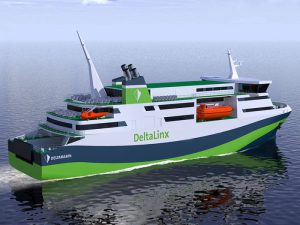
The ready-to-apply DeltaLinx design uses existing technologies to its full potential and integrates them into the smallest possible package, enabling the ferry to operate in small ports and congested harbors. The propulsion system utilizes LNG as fuel to eliminate SOx and to reduce NOX and CO2 in exhaust gases.
A large LNG tank below the car deck is designed for weekly refueling.
The vessel length of approximately 80 meters allows easy operations between smaller towns and congested ports. High-lift rudders and a bow thruster make maneuvering easy.
Reduced resistance and low wash are ensured by streamlined hull lines. To cope with rough weather along the route, an extensive freeboard in the bow area is provided. Additionally fin stabilizers ensure smooth sailing.
The spacious multipurpose passenger facilities allow for seasonal adjustments by operators. They are arranged on two decks and include a spacious restaurant and pub, a children’s area and small spa corner.
Inside and outside seating combined with an exclusive SkyRoom mean that the ferry is an exciting place in all weather conditions.
To make the vessel suitable for disabled persons, a passenger lift from the car deck is provided.
The main car deck can accommodate up to 82 cars (incl. partial mezzanine deck) or 16 trucks. The bow and stern ramp arrangement enables easy drive-through loading and unloading operations. The unobstructed main deck (exhaust casings at sides) also helps to smooth the cargo operations.
The ship’s main dimensions and watertight subdivision ensure compliance with SOLAS 2009 and the Stockholm Agreement. Lifeboats and Mass Evacuation System (MES) are installed onboard for full international as well as domestic voyages. A Man Overboard Boat (MOB) and rescue boats are also provided. Fire safety is ensured by proper fire zone arrangement and state-of-the-art fire-fighting equipment.DeltaLinx main dimensions
Length Lpp 73.10 m Loa 80.40 m Breadth B 18.00 m Draft T 4.00 m Height (car deck) H 6.75 m Deadweight dwt 1,220 t Cargo capacity lane meters 360 lm cars only 82 trucks only 16 Passengers no. 800 persons Service speed V 15 kn. Total propulsion P 6,000 kW Class notation: DNVGL 1A1 Car Ferry A MCDK COMF-C(2)V(2) E0 F-M NAUT-AW CLEAN DESIGN DG-P GAS FUELLED TMON PWDK
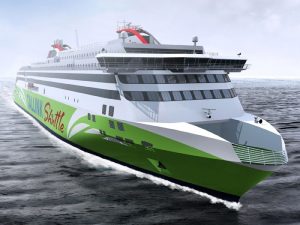
SEPTEMBER 8, 2015 — Espoo, Finland, headquartered Valmet Corporation will supply an automation system for the LNG-powered fast ferry ordered by Estonia’s AS Tallink Grupp at shipbuilder Meyer Turku Oy for its
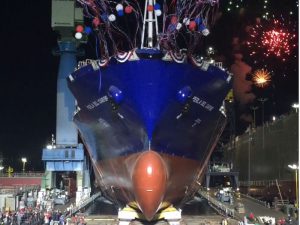
AUGUST 30, 2015 — General Dynamics NASSCO shipyard, San Diego, CA, yesterday launched and christened the second of what will be the world’s first two LNG-fueled containerships. The ship, the Perla del
AUGUST 25, 2015 — VT Halter Marine, Inc.’s Pascagoula, MS, shipyard yesteday laid the keel for the second of two Commitment Class LNG-fueld combination container – Roll-On/Roll-Off (ConRo) ships for Crowley Maritime
AUGUST 4, 2015 — The start of production of Estonian operator Tallink’s new generation LNG fueled fast ferry for the Tallinn, Estonia-Helsinki, Finland, route began today at the Meyer Turku shipyard in