Safety: The Unseen Killer


A shift in the approach to safety management of enclosed spaces on board ships is needed. Fifteen years ago, while working as an independent surveyor, I was carrying out a condition survey on board a bulk carrier. The scope of the survey included testing the emergency generator, located in the steering flat and accessed by an inclined ladder.

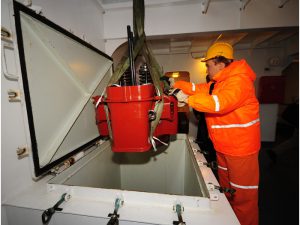
Accompanied by the superintendent and the chief engineer, we had no sooner reached the bottom of the space when the chief engineer urgently ordered us all out. By the time we had exited the space, within seconds, we were all in a state of dizziness and confusion, compounded by our inability to comprehend what had just occurred. Further investigation revealed that Freon gas had leaked from refrigeration machinery located in the steering flat and being heavier than air, had migrated into the emergency generator space, displacing breathable air. It was a lucky escape. Victims of asphyxiation in enclosed spaces deficient in oxygen will normally receive no such warning that anything is wrong or have the ability to quickly escape.

Should we have been aware that this emergency generator space, not being enclosed in the usually perceived sense of the word, was potentially dangerous for entry? Absolutely.

The International Maritime Organization (IMO) currently defines an enclosed space as having any of the following characteristics:

  1. Limited openings for entry and exit;
  2. Inadequate ventilation; and
  3. Is not designed for continuous worker occupancy, and includes, but is not limited to, cargo spaces, double bottoms, fuel tanks, ballast tanks, cargo pump-rooms, cargo compressor rooms, cofferdams, chain lockers, void spaces, duct keels, inter-barrier spaces, boilers, engine crankcases, engine scavenge air receivers, sewage tanks, and adjacent connected spaces. This list is not exhaustive and a list should be produced on a ship-by-ship basis to identify enclosed spaces.”

Most could be forgiven for not considering our generator space to fall within this definition, although it was clearly proven to present a danger in a particular circumstance.

Another very common example of confusion over what actually constitutes an “enclosed space” is the inconsistent perception of the dangers presented by CO2 fixed fire extinguishing system cylinder storage rooms. A leak in the system may accumulate in the space and displace breathable air if not thoroughly ventilated.

Carbon dioxide (CO2) rooms are frequently not identified as enclosed spaces on board and not provided with appropriate warning signs at the space access. Crew members may easily fail to appreciate that a CO2 room should properly be included within the aforementioned definition of an enclosed space.

No atmosphere hazard warning notice
The IMO list of enclosed spaces is not exhaustive, it is therefore important that ship managers and crew apply a wide interpretation as to what spaces on board each vessel could potentially be deficient in oxygen, and/or contain flammable and/or toxic gases or vapours, therefore requiring safety precautions to be observed prior to entry.

The dangers associated with enclosed spaces are well known yet deaths continue to occur.

Part of the issue may be misconceptions as to what spaces are or may become dangerous, and how they are identified. At present, there is no industry standard for the design and siting of warning notices and symbols that may be universally understood by ship and shore personnel. Indeed, on many ships, no attempt is made to provide any such labelling at points of access.

Cargo hold access – No warning notices
Warning notices alone will not overcome the problem as otherwise professional and well trained seafarers continue to enter enclosed spaces. In May last year, three crew members on board a cargo ship lost their lives after entering a cargo hold loaded with sawn timber, a cargo known to cause oxygen depletion.

Another part of the solution must also lie in improved levels of education and training of both ship and shore personnel. Reference is made to IMO Resolution A.1050(27) “Revised Recommendations For Entering Enclosed Spaces Aboard Ships” adopted in 2011. These recommendations provide, inter alia, that shipowners must adopt a comprehensive safety strategy to prevent accidents on entry to enclosed spaces, and that procedures for enclosed space entry are included among the key shipboard operations concerning safety of personnel and the ship. The recommendations also provide that no person should open or enter an enclosed space unless authorized by the master or the nominated responsible person, and unless the appropriate safety precautions laid down for the particular ship have been followed.

Despite the training requirements included in the above revised recommendations, IMO has recognized that more needs to be done to respond to the continuing loss of life from personnel entering shipboard enclosed spaces. This has taken the form of amendments to SOLAS regulation III/19 “Emergency training and drills”, which entered into force on January 1, 2015, and requires that enclosed space entry and rescue drills are to be conducted at two month intervals. The amendments include the following:

“3.6 Enclosed space entry and rescue drills

3.6.1 Enclosed space entry and rescue drills should be planned and conducted in a safe manner, taking into account, as appropriate, the guidance provided in the recommendations developed by the Organization [i.e. Resolution A.1050(27)] .

3.6.2 Each enclosed space entry and rescue drill shall include:

.1 checking and use of personal protective equipment required for entry;

.2 checking and use of communication equipment and procedures;

.3 checking and use of instruments for measuring the atmosphere in enclosed spaces;

.4 checking and use of rescue equipment and procedures; and

.5 instructions in first aid and resuscitation techniques.

4.2 Every crew member shall be given instructions which shall include but not necessarily be limited to:

.5 risks associated with enclosed spaces and on board procedures for safe entry into such spaces which should take into account, as appropriate, the guidance provided in recommendations developed by the Organization.

In addition to these welcome changes, the IMO has recently seen fit to rectify the anomaly that until now, no industry wide requirements have been in place, requiring all vessels to carry atmosphere testing instruments.

For all of this to be effective, it is necessary that ship staff, with the support of shore management, perform mandatory drills, training and actual entry procedures with a dedication and seriousness that reflects the dangers that attend enclosed space entry. A Permit to Work must be fully completed and signed off at the site of the task so that it is contemporary and reflects the actual hazard and safety needs of the operation. All too often, On every occasion before carrying out a job, pre-work meetings or “tool box talks” need to be arranged to identify who does what, the tools needed to identify the risks involved and what to do if something goes wrong.

Drills and training should be properly planned and be used as an opportunity to assess the challenges of rescue from the variously identified enclosed spaces on board. Training should also emphasize to crew the importance of raising the alarm when persons are found to be in difficulty within an enclosed space, and that any rescue is properly coordinated in accordance with practiced procedures.

Comprehensive record keeping and interactive post drill de-briefs will assist in identifying any weaknesses in procedures and promote crew ownership of the training program.

Last but not least, a zero tolerance culture to unplanned and unprepared entry into any enclosed space requires to be rigorously enforced and ingrained into all personnel, on board and ashore.

—By David Nichol, Risk Assessor, UK P&I Club
Are you ready for a TOWBoT?


Drone technology is also finding applications in the maritime industry for the same reasons.

“We see opportunities to use robotics to reduce the danger to crews posed by riskier tug operations, and to reduce costs in some cases,” says Mike Fitzpatrick, President & CEO of Vancouver-based naval architectural firm Robert Allan Ltd. “Control and digital communication technologies developed for drones used in other sectors have reached the point where its transfer to our industry is completely feasible, and is perhaps overdue. These technologies have been used in smaller autonomous surface vessels (ASVs), autonomous mine trucks, autonomous underwater vehicles (AUVs) and aerial drones for years.”

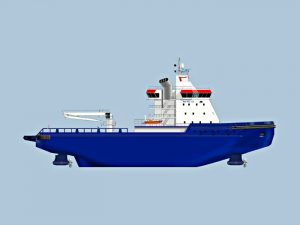
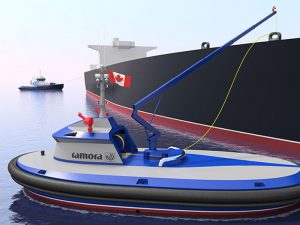
Robert Allan Ltd. (RAL) has just unveiled an autonomous tug concept called the RAmora. The first in the company’s TOWBoT (Tele-Operated Workboat or Tug) series, the RAmora 2400 is a versatile towing platform designed primarily for ship assist and berthing operations. With a bollard pull of 55 tonnes, the RAmora 2400 features a hybrid propulsion system and ample battery storage capacity to enable extended operation even in potentially hazardous environments such as LNG terminals or fire-fighting situations.

The RAmora is operated remotely by a captain on a command tug using a console equipped with live video and other positioning information.  “It is also possible,” explains Fitzpatrick, “for the RAmora captain to operate RAmora away from the console by a bellypack controller when in close visual range.”

The control system design was developed in partnership with International Submarine Engineering of Port Coquitlam, Canada, and is derived from proven remotely operated vehicle, autonomous underwater vehicle and surface vessel applications.


RAmora is fitted with Voith Schneider Propeller (VSP) drives arranged in a fore/aft configuration and its hull form, designed for high stability and good seakeeping performance in waves, is the product of extensive development work including CFD and towing tank testing. Yet, being a TOWBoT with no need for a conventional wheelhouse, crew accommodations, domestic systems or lifesaving equipment, RAmora is simpler and more compact than any conventional tug of comparable performance.


Other features incorporated into the RAmora include off-ship fire-fighting (fi-fi) capability classed to “Fi-Fi 1”, two 1,200 m³/hr fire monitors supplied by electrically-driven fire-fighting pumps, a crane boom that can be optionally fitted with a smaller 600 m³/hr fire monitor and camera.

RAmora can be used for ship handling operations that can put crew at risk, for operations at terminals where ship handling may be required in emergency  situations in hazardous environments, or as a fire fighting asset that can work in close proximity to a toxic fire, or in a restricted space, for extended periods with no risk to crews.

But don’t expect the RAmora to appear in the market overnight. “While the core control and communication technologies are mature,” cautions Fitzpatrick, “there is a lot of work to be done to get to the point where industry, class and regulatory authorities are completely satisfied that safety and reliability meet or exceed what is presently achieved with conventional tugs for the type of ship handling operations that RAmora is intended for. That process could take several years, and we need to be realistic about that. On the other hand, building a prototype RAmora could be done in as little as one to two years since there are no major technological obstacles. We see it as more of an exercise in integrating existing technologies. In many respects, without the normal outfitting required for a crewed tug, RAmora is simpler to build and has considerably fewer systems.”

Pacific Maritime: A vital maritime cluster

 “In the more than seven years that Shell has held leases in the Chukchi, it has only recently been allowed to complete a single well. What we have here is a case in which a company’s commercial efforts could not overcome a burdensome and often contradictory regulatory environment,” says Murkowski. “The Interior Department has made no effort to extend lease terms, as recommended by the National Petroleum Council. Instead, Interior placed significant limits on this season’s activities, which resulted in a drilling rig sitting idle, and is widely expected to issue additional regulations in the coming weeks that will make it even harder to drill. Add this all up, and it is clear that the federal regulatory environment—uncertain, ever-changing, and continuing to deteriorate—was a significant factor in Shell’s decision.”

Murkowski made the point that just because the U.S. has created a difficult environment for offshore drilling in the Arctic, it doesn’t mean other countries have. “Development in the Arctic is going to happen—if not here, then in Russia and Canada, and by non-Arctic nations,” says Murkowski. “I personally believe that America should lead the way. The Arctic is crucial to our entire nation’s future, and we can no longer rely solely on private companies to bring investments in science and infrastructure to the region. As the Arctic continues to open, we urgently need to accelerate our national security investments in icebreakers, ports, and other necessities.”

Some Congressional opponents of Arctic drilling applauded Shell’s move. Senator Jeff Merkley (D-OR) called offshore Arctic drilling “unacceptable” and irresponsible. Rep. Jared Huffman (D-CA) went so far as to introduce the Stop Arctic Ocean Drilling Act of 2015, which would prohibit new or renewed oil and gas leasing in the Arctic Ocean Planning Areas of the Outer Continental Shelf.

But this should probably be viewed more like a pause as opposed to a full stop. A more favorable regulatory environment for Arctic offshore drilling could develop if a Republican is in the White House in 2017 backed by a Republican-controlled Congress. Additionally, cheap oil and gas should also increase consumption and eventually lead to higher prices and make Arctic drilling more economically attractive.


 Shipyards, naval architects team on projects

Portland, OR, headquartered Vigor Industrial, the largest shipyard group in the Pacific Northwest with 12 facilities in Alaska, Washington, and Oregon, had bolstered its capabilities in anticipation of an increased workload. It added an 80,000-ton lifting capacity dry dock to enhance its ship repair and maintenance capabilities and merged with Kvichak Marine Industries, Seattle, WA, to add capabilities in new aluminum vessel construction. Vigor had supported Shell’s earlier efforts in Alaska, including the activation of the drilling barge Kulluk, and more recently repaired the damaged icebreaker Fennica.

Vigor is part of a vibrant Washington State maritime cluster that includes logistics and shipping, fishing and seafood, and shipbuilding and repair. According to a recent economic impact study, generated 148,000 direct and indirect jobs and directly creates $15.2 billion in gross business income and has a total impact of $30 billion on the state’s economy.

Back in March, Vigor “christened” its dry dock Vigourous with work on the cruise ship Norwegian Star and followed that up with repairs to the USNS John Glenn and USNS Montford Point. Now Vigor will turn its attention to completing the third Olympic Class 144-car ferry for Washington State Ferries and look forward to building the fourth in the series, which recently received $122 million in funding by the state legislature. There’s plenty of more coverage on the ferry market in this issue, including Seattle-based Elliott Bay Design Group’s support of ferry projects for the New York City Department of Transportation and Texas Department of Transportation.

Pacific Oct2nicholsSpecial launch system
Designed by Seattle-based naval architectural firm Guido Perla Associates, Inc., the144-car ferry is a joint construction effort between Vigor and neighboring Nichols Brothers Boat Builders, Whidbey Island, WA. Nichols Brothers Boat Builders has been contracted to build the superstructure for the first three Olympic Class ferries. Nichols Brothers Boat Builders has used a new track and dolly system developed by Engineered Heavy Service (EHS), Everett, WA, for transferring the ferry superstructures it on to a barge for transport to assembly with the hull at Vigor Fab in Seattle.

That same transfer system is pictured on this month’s cover, to launch the ATB tug Nancy Peterkin, the first of two 136 ft x 44 ft x 19 ft sister ATB tugs being built for Kirby Offshore Marine.

This past May, Gunderson Marine, Portland, OR, had launched the Kirby 185-01, a oil & chemical tank barge.

The Nancy Peterkin’s sister ATB tug, the Tina Pyne, is set for launch this December.

The EHS launch system moved the ATB from the shipyard to the launch ramp. General Construction provided two floating cranes to assist in the final lifting of the vessel, shuttling it to deeper water.

The vessel was towed to Everett, for lightship, stability testing and fuel transfer. Following this the tug will be towed to Nichols Brothers outfitting pier in Langley, WA, located across the Puget Sound from Everett, WA, for final outfitting, dock and sea trials before its final delivery.

Used for vessels greater than 1,000 tons, the new launch system significantly increases the displacement and draft of the vessels that Nichols Brothers can haul and launch in the future. Currently the shipbuilder is engineering to install ridged buoyancy tanks to the side of the launch frame, eliminating the need for the floating cranes in the future.

Nichols Brothers followed up the launch with the signing of a construction security agreement with Kirby Offshore Marine to build two new 120 ft x 35 ft x 19 ft-3 in tugs. Each tug will be powered by two Caterpillar 3516C, 2,447 bhp at 1,600 rev/min main engines with Reintjes reduction gears turning two NautiCAN fixed pitched propellers with fixed nozzles. Karl Senner, Inc., Kenner, LA, supplied the reduction gears for the vessel. These vessels will also have two C7.1 Caterpillar generators for electrical service. Selected deck machinery includes one TESD-34 Markey tow winch, one CEW-60 Markey electric capstan, and one Smith Berger Tow Pin.

Keels will be laid for both vessels this fall with delivery of the first vessel scheduled for May 2017 and the second vessel is scheduled for delivery in November 2017.

Jensen Maritime Consultants, Seattle, the naval architectural and engineering arm of Crowley Maritime, will provide the ABS Class and functional design for the tugboats. These tugboats will carry an ABS loadline, compliant with USCG, as required at delivery.

Nichols Brothers is currently working on the second ATB Tug for Kirby Offshore Marine.

Nichols Brothers spokesperson Lacey Greene says the shipyard has just begun construction of the American Samoa 140 ft Multi-Purpose Cargo/Passenger Ferry, and next year will begin construction on the superstructure and final assembly of the WETA 400-passenger high speed catamarans.

“The vessel construction boom in the Pacific Northwest has impacted the economy in so many different ways,” says Greene. “Specific to our location our community is flourishing. Nichols Brothers is the largest private employer on Whidbey Island in Washington State and employs 300 men and women. We foresee the economic boom expanding even further; the tug market is strong in all aspects, from ATB tugs, tractor Tugs, to line tugs. We also see the passenger vessel industry sector thriving, and we predict additional passenger only high-speed ferries coming down the pipeline as well as leisure vessels.”


 Jensen Maritime is also providing construction management services for the Crowley product tankers under construction at Aker Philadelphia Shipyard. It’s also been busy working on developing LNG bunker barge concepts and recently received approval from ABS for a 452 ft-long ATB version.

Engineering consultant Art Anderson Associates, Bremerton, WA, has been increasing its staff and supporting the development of passenger-only ferry service in Puget Sound. Art Anderson’s Patrick R. Vasicek, PE, LEED AP, will be on hand at the Marine Log FERRIES 2015 Conference & Expo in Seattle to discuss, “An Exportable Life Cycle Assessment Tool for Determining Sustainable Visibility of Passenger-Only Ferry Routes and Systems.”

Ballast water treatment solution
Seattle-based naval architectural and engineering consultancy Glosten reports that Marine Systems Inc. (MSI) has delivered a pair of Ballast Treatment System Deck Modules, designed for tank barge and ship operations.

MSI turned to Glosten to develop the design in response to requests from vessel operators and the first of a kind modular ballast water treatment units combine expertise from Glosten, MSI and Alfa Laval, which provided PureBallast 3.1 treatment systems, Filtrex high efficiency filters, and expertise from hundreds of ballast water management system installations.

The resulting modules, built at the Foss Seattle Shipyard, complete with lighting, ventilation, and integrated controls, were shipped ready for “plug-and-play.”

Each Ballast Module packs a treatment capacity of 1,000 m3/hr within a 20-foot shipping container footprint and is ABS and U.S. Coast Guard approved for hazardous area installations.

Using the module reduces the technical demands on busy shipyards. Rather than juggling independent components and vendors, shipyards can instead focus on fabricating a few well-defined interfaces and foundation system. Each purchased module comes pre-approved by USCG and ABS, is fully tested prior to shipment, and includes integration support from MSI and Glosten engineers.

“The demands of the vessel operator drove this design,” says Kevin Reynolds, Principal at Glosten. “Doing this as a manufactured product ensures that we get it right, every time.”

Get Green Financing

October 13, 2015 — Liberian Registry, EfficientShip Finance launch Eco-Upgrade Financing Initiative (Extended coverage from Marine Log’s October 2015 issue). To remain competitive with the new generation of Eco-ships, ship owners of

Finance: Attractive Terms

October 13, 2015 — Hapag-Lloyd secures banking facility for boxship series at Hyundai Samho Heavy Industries (Extended coverage from Marine Log’s October 2015 issue). German container shipping giant Hapag-Lloyd signed a $

Coast Guard to review WSF LNG terminal proposal

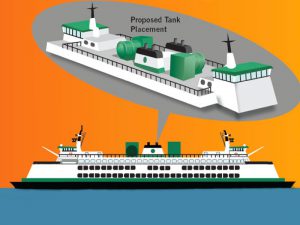
The U.S. Coast Guard recently issued a notice in the Federal Register that it would review a proposal by Washington State Ferries (WSF) to modify its marine terminal operations to handle Liquefied Natural Gas (LNG). The LNG would be used to fuel its six Issaquah Class ferries. Last year on June 27, the Coast Guard Sector Puget Sound had received a Letter of Intent (LOI) and a Waterway Suitability Assessment (WSA) from Washington State Ferries to modify their marine terminals to handle LNG.

In accordance with regulation and policy guidance, the Captain of the Port (COTP), Coast Guard Puget Sound Sector, in cooperation with key stakeholders, will review and validate the information in the WSA. Once the COTP reviews the WSA, he will issue a Letter of Recommendation to the Washington Department of Transportation recommending the suitability of the Puget Sound waterways that will be used for LNG marine traffic as it relates to safety and security. Public comments received last November regarding WSF’s proposal will be considered in the development of the COTP’s Letter of Recommendation. Some of the comments received expressed concern about the exposed location of the LNG tanks on the top deck of the converted ferries and how they could potentially pose a security threat. Other comments thought that LNG poses a pollution threat to the environment. The Coast Guard will examine WSF’s Emergency and Operations Manuals covering the LNG transfer system and transfer procedures.

Proposed conversion
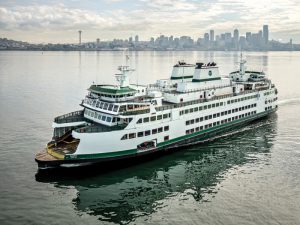
Once WSF receives the Letter of Recommendation from the Coast Guard, it will be able to move forward with the retrofit of the first Issaquah Class ferry, which will serve as a proof of concept for the remaining vessels in the class. The diesel-powered ferries carry about 1,200 passengers and 124 vehicles.The state’s ferries, says WSF, are the largest single source of marine carbon emissions in the state. It expects to cut CO2, particulate matter, SOx, and NOx emissions significantly with the use of LNG s a marine fuel. The WSDOT also expects to reap some cost savings, although the picture is not as compelling as it was last year when oil was at $100 per barrel.

During testimony this past January before a State Senate Energy, Environment and Telecommunication Subcommittee, Lynne Griffith, Assistant Secretary of Transportation, Ferries Division, said there would be a $1 per gallon savings when burning LNG as compared with burning Ultra Low Sulfur Diesel. WSF burns about 18 million gallons of fuel annually. The cost of fuel now represents about 23 percent of the Fiscal Year 2013-2015 operating budget as compared with 11 percent in Fiscal Year 2000-2001. Any ferries that would burn LNG would have to be refueled by tanker truck every seven to 10 days.

Ferries: Reconnecting with the water

But like many ferry services in the U.S., the SSA’s workhorse fleet is aging. The nine vessels in the authority’s fleet have an average age of 30 years old. The 60-year-old Governor, which in a previous life served Governors Island in New York Harbor, will be replaced in 2017 by the M/V Woods Hole, a new ferry under construction at Conrad Shipyard in Morgan City, LA. Conrad Shipyard won the tender to build the ferry with a $36,448,000 million bid.

The ferry is designed by Elliott Bay Design Group (EBDG), Seattle, WA, whose name is synonymous with ferry design in the U.S. Besides the SSA ferry project, EBDG naval architects are currently working on the Alaska Class Day Boat, the Fisher Island ferry, and the Staten Island Ferry.

EBDG’s Brian King, Vice President of Engineering, says the construction of the new SSA ferry has now reached a significant construction milestone with the launching of the hull.  The hull was launched upside down and then righted while in the water by use cranes. Pre-built superstructure assemblies are now being installed on the deck.

Oct Ferry2When MARINE LOG visited Conrad Shipyard in August, the Woods Hole had yet to be launched, but its highly shaped bulbous bow was in place.

When designing the Woods Hole, particular attention was focused on ship’s planned powering and seakeeping characteristics, as well as efficiency.

King says the ferry is designed to achieve sprint speeds of 16 knots but will more typically operate at 12 to 14 knots.  The ferry’s highly shaped bulbous bow was designed to minimize wake and improve fuel efficiency.  EBDG used Computational Fluid Design (CFD) analysis to optimize the hull and bulbous bow design.

The results of the CFD analysis was validated and further optimized in FORCE Technology’s towing tank in Denmark.  While there are many fuel efficiency design features, the bulbous bow alone is estimated to provide fuel efficiency improvements of 3% over a conventional bow, according to King. Test results on a custom-made model built by FORCE Technology indicated that the vessel’s hull deign will be very efficient, requiring less than 2,500 hp to operate at a service speed of 14 knots, and that the vessel’s wake is expected to be minimal, even at speeds of 9 knots.

King says the Woods Hole has been specially designed to carry freight, but is also suited for walk-on passenger and car traffic.  The freight-vehicle deck is designed to carry ten 100,000 lb tractor-trailers with straight through end-to-end loading.  When not carrying a full load of tractor-trailers the freight-vehicle deck can accommodate approximately 55 standard passenger vehicles.  Passenger plus crew capacity is 384.

The Woods Hole is 235 ft long, with a beam of 64 ft, and maximum draft is limited to 10 ft 6 in. at full load due to port restrictions.  For simplified maintenance and crew oversight, passenger accommodations are all on a single deck above the freight deck with seating indoors and outside.  Food service, Wifi, cell service and television will be provided.  Crew accommodations are located on the deck above the passenger deck located behind the wheelhouse, which has been elevated for excellent visibility all around. 

The main propulsion power is supplied by two EPA Tier 3-compliant, 2,680-hp MTU 16V4000 engines connected to Hundested controllable pitch propellers.  Controllable pitch was chosen to allow propeller pitch and shaft RPM combinations that provide excellent low speed maneuvering responsiveness and still provide optimized fuel efficiency at all speeds.

Radiated noise is minimized through use of resiliently mounted main engines and generators and critical grade silencers.

Fuel, oil and waste tanks are all safely isolated from the hull.

Maneuverability and efficiency
King says that special attention has been devoted to fuel efficiency, least environmental impact and low speed maneuvering. For maneuvering and steering, the ferry will be fitted with Becker high-lift rudders located in line with the propeller shafts to improve fuel efficiency.  A vectorable Tees—White Gill bow thruster in combination with the controllable pitch propeller system and high lift rudders will provide the Woods Hole with extremely good maneuverability in a tight quarters.  King says the bow thruster, rudders, and CP system will also allow the ferry to turnaround and accelerate with very little wake wash. 

The Woods Hole is expected to be delivered in May 2016 and enter service in 2017.

New ferry for Texas
When you are driving on Texas State Highway 361, the only way to get across Corpus Christi Channel from Aransas Pass to Port Aransas, is by the Port Aransas ferry. The ferry service runs 24 hours a day, seven days a week. The quarter-mile route typically takes less than 10 minutes across, although peak summer hours may require drivers to wait longer.

Each ferry can carry up to 20 regular passenger vehicles. Combined vehicles, such as a truck towing a boat, may not be longer than 80 feet, wider than 13 feet or taller than 13 feet 6 inches. Single-axle vehicles may weigh no more than 20,000 pounds, tandem axles no more than 34,000 pounds and combination vehicles may not exceed a total of 80,000 pounds.

The ferries are owned by the Texas Department of Transportation (TxDOT), which recently awarded a contract to Southwest Shipyard, Houston, TX, to construct a 28-car ferry. When delivered in February 2017, the new ferry will be the third of a class designed by EBDG. EBDG, which will act as the owner’s representative for the project when construction begins this fall, signed a deal with TxDOT in 2014 to provide four years of on-call service. This is the first contract under the service agreement.

Unlike the two previous ferries built to this design and delivered in 2011, the new ferry will be a diesel-electric ferry. It will be classed by ABS and will have a length of 161 feet overall, a beam of 52 feet, a depth of approximately 11 feet and a draft of 8 feet.

Design updates to the interior, including the propulsion system, will translate into a vessel that has greater built-in redundancy and requires less maintenance over its lifetime.

North Carolina DOT looks at adding passenger-only ferry
Meanwhile, North Carolina Department of Transportation (NCDOT) is conducting a Passenger Feasibility Study that could lead to a new passenger-only ferry service between Hatteras Village and Oracoke’s Silver Harbor by the summer of 2017. The new service would start with either two 80-passenger ferries or one 150-passenger vessel. The passenger-only ferries would be in addition to the Ferry Division’s current car ferry service.

Oct Ferry3The passenger-only ferry service is seen as a possible way to boost tourism to Oracoke Island, which has seen a 250,000 visitor drop off from its peak of about 1 million in 2007. The passenger-only ferry service will also reduce long lines of autos during the summer for the car ferries. Parking on the island is scarce, too.

The study says the new ferry service would make four round trips per day, carrying 125,000 passengers in the first year at a cost of $15 per round trip. New visitor spending would reach $500,000 in the first year.

By 2020, the construction of permanent docking terminals would be complete and additional passenger-only vessels would be added.

This past summer, the NCDOT Ferry Division held meetings in Oracoke and Hatteras to gather the public’s input.
The passenger ferries would drop visitors off directly in Ocracoke Village, where Hyde County would provide tram service around the village and to attractions such as the Ocracoke Lighthouse and the British Cemetery.

“There are a lot of moving parts here, but if they all come together, this could solve a lot of the issues for Ocracoke visitation,” says Ferry Division Director Ed Goodwin. “It would ease the backups we have on the car ferry route, and bring more visitors with fewer cars into the village. On the surface, it seems like a win-win all around.”

Other solutions are included in the study as well, such as year-round dredging of the now-closed “short” car ferry route, putting more car ferries into service on the current route, or loading more walk-on passengers onto the existing departures. But each of those comes with its own expense and logistical issues.

The Passenger Ferry Feasibility Study being conducted by Volkert Inc., Raleigh, NC, for the state began earlier this year and has included test runs of the possible ferry route, passenger surveys, and meetings with the public and stakeholders. It has also identified the kind of infrastructure and parking improvements that would be needed before service begins. The study is due to be completed by the end of this year.

Oct Ferry4Staten Island Ferry draws interest
Any time you board the Staten Island ferry at the Whitehall Ferry Terminal in lower Manhattan for the five-mile trip across New York Harbor, you are bound to hear at least four different languages spoken by your fellow passengers. The iconic orange ferry fleet is one of the city’s biggest annual tourist attractions, providing a free ride with priceless views of Governors Island, Ellis Island, the Statue of Liberty and the Verrazano Bridge. The New York City Department of Transportation, owner and operator of the fleet, is in the process of developing a new class of boats to replace the 1965-built John F. Kennedy and the 1980’s vintage Andrew J. Barberi and Samuel I. Newhouse.

NYCDOT held an industry day on September 16 in New York outlining the project scope, bid process, and development and construction timeline for the 4,500-passenger New Kennedy Class ferries for the Staten Island Ferry. EBDG, lead naval architect on the project was on hand, along with representatives from Conrad Shipyard, Morgan City, LA, Fincantieri Bay Shipbuilding, Sturgeon Bay, WI, Eastern Shipbuilding, Panama City, FL, VT Halter Marine, Pascagoula, MS, Dakota Creek Industries, Anacortes, WA, Leevac Shipyards, Jennings, LA, Vigor Industrial, Portland, OR, and General Dynamics NASSCO, San Diego, CA, and some key suppliers.

The city has received funding of $309 million towards the three boats, which will be 320 ft long by 70 ft, with EPA Tier 4 compliant diesel engines and a Voith Schneider propulsion system. The ferries are expected to retain some of the design elements of the beloved Kennedy Class, while incorporating energy and fuel-saving technologies.

Once the construction contract is finalized in the fourth quarter of 2016, all three ferries must be completed within a four-year time frame.

Expanding East River ferry service
Some of New York Mayor Bill deBlasio’s policies and initiatives have been downright forehead slapping. His handling of the homeless and push towards removing horse-drawn carriages from city streets have been baffling. His consideration of tearing up pedestrian plazas in Times Square to reopen up them to vehicle traffic as a means of removing painted topless women from the area is just plain dumb.

But the Mayor should be given credit for announcing the launching of expanded citywide ferry services in 2017 and 2018 that would connect neighborhoods that are “starved of adequate mass transit,” in the words of State Senator Michael Gianaris. The expanded ferry services across the East River to Astoria, the Rockaways, South Brooklyn, the Lower East Side and Soundview would run seven days a week and cost $2.75 each way—the same as a city subway or bus. Future service would connect Coney Island and the Stapleton section of Staten Island.

Washington State gets funding for fourth ferry
The good news for Washington State Ferries is that this past summer Washington Governor Islee approved $122 million in the state budget for the construction of a badly needed fourth 144-car Olympic Class ferry.

WSF is building new Olympic Class ferries to replace some of the fleet’s oldest vessels. The Olympic Class design is based on the Issaquah class—the same ferries that have been the subject of a proposed midlife conversion to burn Liquefied Natural Gas.

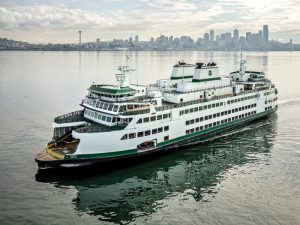
Designed by Seattle-based Guido Perla & Associates, Inc., the Olympic Class vessels have a capacity of 144 cars and 1,500 passengers and are 362 ft 3 in long x 83 ft 2 in wide. Main propulsion is by two Electro-Motive Diesel engines developing a total 6,000 hp and giving the vessels a speed of 17 knots.

Two of the Olympic Class ferries, the Tokitae and Samish, are in service, and a third is under construction at Vigor in Seattle for delivery in 2017. As in the first two ferries, Nichols Brothers Boat Builders, Whidbey Island, WA, is building the superstructure. The fourth is scheduled for completion in the fall of 2018. 

WSF is building new vessels to replace our 1950s-era Evergreen State Class ferries. Nine of 24 vessels in its fleet are between 40 and 60 years old. These older ferries are approaching the end of their service lives and must be replaced with newer ones in the coming years.

New King County ferry starts service
King County’s newest vessel, the M/V Doc Maynard, started service on the Vashon route on September 29 sailing from Pier 50.  The ferry replaced her sister ship, the M/V Sally Fox, which is being removed from service for scheduled warranty work.

Both the Sally Fox and Doc Maynard will built by All American Marine, Inc. (AAM), Bellingham, WA. The 105 ft x 33 ft aluminum catamaran ferries are the first U.S. Coast Guard Sub-chapter “K” inspected passenger vessels built and delivered under new guidelines that make it possible for boat builders to design and implement suitable structural fire protection in very low fire load spaces in the construction of weight-sensitive high speed passenger vessels.

AAM partnered with naval architecture firm, Teknicraft Design Ltd., of Auckland, New Zealand for the hull design. The advanced hull shape was custom designed using digital modeling and Computational Fluid Dynamics (CFD) analysis testing.

The hull design is complemented by Teknicraft’s signature integration of a wave piercer positioned between the catamaran sponsons to break up wave action and ensure reduced drag while enhancing passenger comfort.

All American Marine is the exclusive builder for Teknicraft Design Ltd. catamarans in North America.

Each ferry is powered by two Cummins QSK-50 Tier 3 diesel engines, rated at 1,800 bhp at 1,900 rev/min and driving twin propellers to provide a service speed of 28 knots.

The ferries also burn a 10 percent biodiesel blend and have LED lighting onboard.

The design features interior seating for 250 with 28 additional outdoor seats available on the upper aft deck.

With traffic congestion on roads and bridges continuing to plague area commuters, King County is also exploring a plan to possibly add ferry service on Lake Washington, something that has happened since the 1950s.

MARINE LOG FERRIES 2015 Exclusive: Tour the new boat
All American Marine is sponsoring a tour of the Doc Maynard at MARINE LOG’S FERRIES 2015 Conference & Expo, set for November 5-6, 2015 at the Hyatt Olive 8 in Seattle. As part of the tour, Joe Hudspeth, Vice President of Business Development, All American Marine and Paul Brodeur, Director of King County Marine Division, will jointly discuss the features and capabilities of the new ferries. Those interested in the tour should sign up early as space is limited. See marinelog.com/events for more details.

-By John R. Snyder, Publisher and Editor-in-Chief


Ferries: Reconnecting with the water

But like many ferry services in the U.S., the SSA’s workhorse fleet is aging. The nine vessels in the authority’s fleet have an average age of 30 years old. The 60-year-old Governor, which in a previous life served Governors Island in New York Harbor, will be replaced in 2017 by the M/V Woods Hole, a new ferry under construction at Conrad Shipyard in Morgan City, LA. Conrad Shipyard won the tender to build the ferry with a $36,448,000 million bid.

The ferry is designed by Elliott Bay Design Group (EBDG), Seattle, WA, whose name is synonymous with ferry design in the U.S. Besides the SSA ferry project, EBDG naval architects are currently working on the Alaska Class Day Boat, the Fisher Island ferry, and the Staten Island Ferry.

EBDG’s Brian King, Vice President of Engineering, says the construction of the new SSA ferry has now reached a significant construction milestone with the launching of the hull.  The hull was launched upside down and then righted while in the water by use cranes. Pre-built superstructure assemblies are now being installed on the deck.

Oct Ferry2When MARINE LOG visited Conrad Shipyard in August, the Woods Hole had yet to be launched, but its highly shaped bulbous bow was in place.

When designing the Woods Hole, particular attention was focused on ship’s planned powering and seakeeping characteristics, as well as efficiency.

King says the ferry is designed to achieve sprint speeds of 16 knots but will more typically operate at 12 to 14 knots.  The ferry’s highly shaped bulbous bow was designed to minimize wake and improve fuel efficiency.  EBDG used Computational Fluid Design (CFD) analysis to optimize the hull and bulbous bow design.

The results of the CFD analysis was validated and further optimized in FORCE Technology’s towing tank in Denmark.  While there are many fuel efficiency design features, the bulbous bow alone is estimated to provide fuel efficiency improvements of 3% over a conventional bow, according to King. Test results on a custom-made model built by FORCE Technology indicated that the vessel’s hull deign will be very efficient, requiring less than 2,500 hp to operate at a service speed of 14 knots, and that the vessel’s wake is expected to be minimal, even at speeds of 9 knots.

King says the Woods Hole has been specially designed to carry freight, but is also suited for walk-on passenger and car traffic.  The freight-vehicle deck is designed to carry ten 100,000 lb tractor-trailers with straight through end-to-end loading.  When not carrying a full load of tractor-trailers the freight-vehicle deck can accommodate approximately 55 standard passenger vehicles.  Passenger plus crew capacity is 384.

The Woods Hole is 235 ft long, with a beam of 64 ft, and maximum draft is limited to 10 ft 6 in. at full load due to port restrictions.  For simplified maintenance and crew oversight, passenger accommodations are all on a single deck above the freight deck with seating indoors and outside.  Food service, Wifi, cell service and television will be provided.  Crew accommodations are located on the deck above the passenger deck located behind the wheelhouse, which has been elevated for excellent visibility all around. 

The main propulsion power is supplied by two EPA Tier 3-compliant, 2,680-hp MTU 16V4000 engines connected to Hundested controllable pitch propellers.  Controllable pitch was chosen to allow propeller pitch and shaft RPM combinations that provide excellent low speed maneuvering responsiveness and still provide optimized fuel efficiency at all speeds.

Radiated noise is minimized through use of resiliently mounted main engines and generators and critical grade silencers.

Fuel, oil and waste tanks are all safely isolated from the hull.


Maneuverability and efficiency
King says that special attention has been devoted to fuel efficiency, least environmental impact and low speed maneuvering. For maneuvering and steering, the ferry will be fitted with Becker high-lift rudders located in line with the propeller shafts to improve fuel efficiency.  A vectorable Tees—White Gill bow thruster in combination with the controllable pitch propeller system and high lift rudders will provide the Woods Hole with extremely good maneuverability in a tight quarters.  King says the bow thruster, rudders, and CP system will also allow the ferry to turnaround and accelerate with very little wake wash. 


The Woods Hole is expected to be delivered in May 2016 and enter service in 2017.

New ferry for Texas
When you are driving on Texas State Highway 361, the only way to get across Corpus Christi Channel from Aransas Pass to Port Aransas, is by the Port Aransas ferry. The ferry service runs 24 hours a day, seven days a week. The quarter-mile route typically takes less than 10 minutes across, although peak summer hours may require drivers to wait longer.

Each ferry can carry up to 20 regular passenger vehicles. Combined vehicles, such as a truck towing a boat, may not be longer than 80 feet, wider than 13 feet or taller than 13 feet 6 inches. Single-axle vehicles may weigh no more than 20,000 pounds, tandem axles no more than 34,000 pounds and combination vehicles may not exceed a total of 80,000 pounds.

The ferries are owned by the Texas Department of Transportation (TxDOT), which recently awarded a contract to Southwest Shipyard, Houston, TX, to construct a 28-car ferry. When delivered in February 2017, the new ferry will be the third of a class designed by EBDG. EBDG, which will act as the owner’s representative for the project when construction begins this fall, signed a deal with TxDOT in 2014 to provide four years of on-call service. This is the first contract under the service agreement.

Unlike the two previous ferries built to this design and delivered in 2011, the new ferry will be a diesel-electric ferry. It will be classed by ABS and will have a length of 161 feet overall, a beam of 52 feet, a depth of approximately 11 feet and a draft of 8 feet.

Design updates to the interior, including the propulsion system, will translate into a vessel that has greater built-in redundancy and requires less maintenance over its lifetime.

North Carolina DOT looks at adding passenger-only ferry
Meanwhile, North Carolina Department of Transportation (NCDOT) is conducting a Passenger Feasibility Study that could lead to a new passenger-only ferry service between Hatteras Village and Oracoke’s Silver Harbor by the summer of 2017. The new service would start with either two 80-passenger ferries or one 150-passenger vessel. The passenger-only ferries would be in addition to the Ferry Division’s current car ferry service.

Oct Ferry3The passenger-only ferry service is seen as a possible way to boost tourism to Oracoke Island, which has seen a 250,000 visitor drop off from its peak of about 1 million in 2007. The passenger-only ferry service will also reduce long lines of autos during the summer for the car ferries. Parking on the island is scarce, too.

The study says the new ferry service would make four round trips per day, carrying 125,000 passengers in the first year at a cost of $15 per round trip. New visitor spending would reach $500,000 in the first year.

By 2020, the construction of permanent docking terminals would be complete and additional passenger-only vessels would be added.

This past summer, the NCDOT Ferry Division held meetings in Oracoke and Hatteras to gather the public’s input.
The passenger ferries would drop visitors off directly in Ocracoke Village, where Hyde County would provide tram service around the village and to attractions such as the Ocracoke Lighthouse and the British Cemetery.

“There are a lot of moving parts here, but if they all come together, this could solve a lot of the issues for Ocracoke visitation,” says Ferry Division Director Ed Goodwin. “It would ease the backups we have on the car ferry route, and bring more visitors with fewer cars into the village. On the surface, it seems like a win-win all around.”

Other solutions are included in the study as well, such as year-round dredging of the now-closed “short” car ferry route, putting more car ferries into service on the current route, or loading more walk-on passengers onto the existing departures. But each of those comes with its own expense and logistical issues.

The Passenger Ferry Feasibility Study being conducted by Volkert Inc., Raleigh, NC, for the state began earlier this year and has included test runs of the possible ferry route, passenger surveys, and meetings with the public and stakeholders. It has also identified the kind of infrastructure and parking improvements that would be needed before service begins. The study is due to be completed by the end of this year.


Oct Ferry4Staten Island Ferry draws interest
Any time you board the Staten Island ferry at the Whitehall Ferry Terminal in lower Manhattan for the five-mile trip across New York Harbor, you are bound to hear at least four different languages spoken by your fellow passengers. The iconic orange ferry fleet is one of the city’s biggest annual tourist attractions, providing a free ride with priceless views of Governors Island, Ellis Island, the Statue of Liberty and the Verrazano Bridge. The New York City Department of Transportation, owner and operator of the fleet, is in the process of developing a new class of boats to replace the 1965-built John F. Kennedy and the 1980’s vintage Andrew J. Barberi and Samuel I. Newhouse.


NYCDOT held an industry day on September 16 in New York outlining the project scope, bid process, and development and construction timeline for the 4,500-passenger New Kennedy Class ferries for the Staten Island Ferry. EBDG, lead naval architect on the project was on hand, along with representatives from Conrad Shipyard, Morgan City, LA, Fincantieri Bay Shipbuilding, Sturgeon Bay, WI, Eastern Shipbuilding, Panama City, FL, VT Halter Marine, Pascagoula, MS, Dakota Creek Industries, Anacortes, WA, Leevac Shipyards, Jennings, LA, Vigor Industrial, Portland, OR, and General Dynamics NASSCO, San Diego, CA, and some key suppliers.

The city has received funding of $309 million towards the three boats, which will be 320 ft long by 70 ft, with EPA Tier 4 compliant diesel engines and a Voith Schneider propulsion system. The ferries are expected to retain some of the design elements of the beloved Kennedy Class, while incorporating energy and fuel-saving technologies.

Once the construction contract is finalized in the fourth quarter of 2016, all three ferries must be completed within a four-year time frame.

Expanding East River ferry service
Some of New York Mayor Bill deBlasio’s policies and initiatives have been downright forehead slapping. His handling of the homeless and push towards removing horse-drawn carriages from city streets have been baffling. His consideration of tearing up pedestrian plazas in Times Square to reopen up them to vehicle traffic as a means of removing painted topless women from the area is just plain dumb.

But the Mayor should be given credit for announcing the launching of expanded citywide ferry services in 2017 and 2018 that would connect neighborhoods that are “starved of adequate mass transit,” in the words of State Senator Michael Gianaris. The expanded ferry services across the East River to Astoria, the Rockaways, South Brooklyn, the Lower East Side and Soundview would run seven days a week and cost $2.75 each way—the same as a city subway or bus. Future service would connect Coney Island and the Stapleton section of Staten Island.

Washington State gets funding for fourth ferry
The good news for Washington State Ferries is that this past summer Washington Governor Islee approved $122 million in the state budget for the construction of a badly needed fourth 144-car Olympic Class ferry.

WSF is building new Olympic Class ferries to replace some of the fleet’s oldest vessels. The Olympic Class design is based on the Issaquah class—the same ferries that have been the subject of a proposed midlife conversion to burn Liquefied Natural Gas.

Designed by Seattle-based Guido Perla & Associates, Inc., the Olympic Class vessels have a capacity of 144 cars and 1,500 passengers and are 362 ft 3 in long x 83 ft 2 in wide. Main propulsion is by two Electro-Motive Diesel engines developing a total 6,000 hp and giving the vessels a speed of 17 knots.

Two of the Olympic Class ferries, the Tokitae and Samish, are in service, and a third is under construction at Vigor in Seattle for delivery in 2017. As in the first two ferries, Nichols Brothers Boat Builders, Whidbey Island, WA, is building the superstructure. The fourth is scheduled for completion in the fall of 2018. 

WSF is building new vessels to replace our 1950s-era Evergreen State Class ferries. Nine of 24 vessels in its fleet are between 40 and 60 years old. These older ferries are approaching the end of their service lives and must be replaced with newer ones in the coming years.

New King County ferry starts service
King County’s newest vessel, the M/V Doc Maynard, started service on the Vashon route on September 29 sailing from Pier 50.  The ferry replaced her sister ship, the M/V Sally Fox, which is being removed from service for scheduled warranty work.

Both the Sally Fox and Doc Maynard will built by All American Marine, Inc. (AAM), Bellingham, WA. The 105 ft x 33 ft aluminum catamaran ferries are the first U.S. Coast Guard Sub-chapter “K” inspected passenger vessels built and delivered under new guidelines that make it possible for boat builders to design and implement suitable structural fire protection in very low fire load spaces in the construction of weight-sensitive high speed passenger vessels.

AAM partnered with naval architecture firm, Teknicraft Design Ltd., of Auckland, New Zealand for the hull design. The advanced hull shape was custom designed using digital modeling and Computational Fluid Dynamics (CFD) analysis testing.

The hull design is complemented by Teknicraft’s signature integration of a wave piercer positioned between the catamaran sponsons to break up wave action and ensure reduced drag while enhancing passenger comfort.

All American Marine is the exclusive builder for Teknicraft Design Ltd. catamarans in North America.

Each ferry is powered by two Cummins QSK-50 Tier 3 diesel engines, rated at 1,800 bhp at 1,900 rev/min and driving twin propellers to provide a service speed of 28 knots.

The ferries also burn a 10 percent biodiesel blend and have LED lighting onboard.

The design features interior seating for 250 with 28 additional outdoor seats available on the upper aft deck.

With traffic congestion on roads and bridges continuing to plague area commuters, King County is also exploring a plan to possibly add ferry service on Lake Washington, something that has happened since the 1950s.

MARINE LOG FERRIES 2015 Exclusive: Tour the new boat
All American Marine is sponsoring a tour of the Doc Maynard at MARINE LOG’S FERRIES 2015 Conference & Expo, set for November 5-6, 2015 at the Hyatt Olive 8 in Seattle. As part of the tour, Joe Hudspeth, Vice President of Business Development, All American Marine and Paul Brodeur, Director of King County Marine Division, will jointly discuss the features and capabilities of the new ferries. Those interested in the tour should sign up early as space is limited. See marinelog.com/ferries for more details.

-By John R. Snyder, Publisher and Editor-in-Chief


SIU creates fund for family of seafarers of El Faro

OCTOBER 12, 2015—The Seafarers International Union (SIU) has launched a voluntary fund to help the dependents of the seafarers who perished in the sinking of the U.S.-flag containership El Faro.  SIU Secretary-Treasurer

Wartsila engines for new Russian icebreaker

OCTOBER 9, 2015—This past September, Wärtsilä signed an order to supply its new medium-speed Wärtsilä 31 engine for a new generation icebreaker currently under construction at the PJSC Vyborg Shipyard in Russia.

LOAD MORE