AEU’s Rob Stuardi appointed to key SCA committee

AEU is the program administrator for American Longshore Mutual Association (ALMA), a group mutual association which is authorized by the U.S. Department of Labor to provide USL&H coverage in all 50 states.

AEU is a member of the SCA based on its longstanding support of the U.S. shipbuilding and repair industry.

“This is a high visibility position in the industry and within the SCA where the Committee represents the 88 Industry Partner members of the SCA disseminating information about SCA activities to the Industry Partners, responding to their concerns, and representing them to the overall SCA Board of Directors,” said AEU’s Jack Martone, one of the founding members of the SCA Industry Partner’s Committee in 2012.

Maersk Line to cut jobs, scale back shipbuilding plans

Those initiatives will see it reduce network capacity, shed “at least 4,000” jobs by the end of 2017 and cut back on the ambitious shipbuilding plans announced earlier. It will not exercise previously announced options for six 19,630 TEU vessels and two 3,600 TEU feeders and will postpone its decision on an optional eight 14,000 TEU vessels.

Maersk Line says that, in light of lower demand, these moves will still allow it to grow at least in line with the market to defend its market leading position.

Over the next two years, Maersk Line expects to lower the annual Sales, General & Administration (SG&A) cost run-rate by  $250 million with an impact of $150 million in 2016. SG&A savings will be derived from already initiated transformation projects and the standardization, automation and digitalization of processes.
 
“We are on a journey to transform Maersk Line. We will make the organization leaner and simpler. We want to improve our customer experience digitally and at the same time work as efficiently as possible,” says CEO Søren Skou.

Today, Maersk Line has 23,000 land based staff globally. Organizational transformation and on-going automation and digitalization will, it says, enable it to reduce the global organization by at least 4,000 positions by the end of 2017 with the aim of minimizing redundancies through managing natural attrition.

“We are fewer people today than a year ago. We will be fewer next year and the following year. These decisions are not taken lightly, but they are necessary steps to transform our industry,” says Mr. Skou.

As a response to the current market outlook, network capacity will be reduced in Q4 2015 and throughout 2016. As previously announced, the closure of four  services (ME5, AE9, AE3 and TA4) has already been initiated over the last two months and plans are in place to further cancel a total of 35 sailings in Q4.

Crystal ups river cruise orders at Lloydwerft, buys Mozart

Crystal Cruises’ parent company, Genting Hong Kong, entered into an agreement to acquire the shipyard in September, investing EUR 17.5 million for 70% of the new shipbuilding business and a 50% ownership of the shipyard’s land.

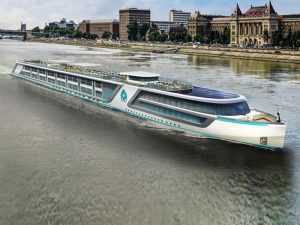
The decision to double the number of river cruise vessel newbuilds comes just months after Crystal Cruises unveiled its intention to embark on what it calls the “most significant brand expansion in the luxury travel and hospitality history” with the addition of Crystal River Cruises, Crystal Yacht Cruises, Crystal Exclusive Class ocean vessels and Crystal Luxury Air.

President and CEO Edie Rodriguez reported today that in addition to adding two more river vessels at the Bremerhaven shipyard, responding to strong demand from travelers and agents for an earlier Crystal river experience, Crystal has also completed the purchase of the German built MS Mozart, the largest river cruise vessel in Europe.

Following an extensive drydocking to create the upscale Crystal experience on board, the revamped vessel will be renamed Crystal Mozart and start Danube River cruises in July next year.
 

“In response to travelers and travel agents’ enthusiasm for Crystal River Cruises, and through Crystal’s innovation, we are upping the ante once again, bringing ‘true luxury’ to the river cruise sector with the largest guest suites and public spaces, the highest crew-to-guest-ratio and Crystal’s award-winning service,” said Mr. Rodriguez. “Once the transformation of Crystal Mozart is completed, it will truly be the crown jewel of the European rivers.”

Crystal Mozart is designed to fit into the wider locks of the Danube River from Passau in Germany to Budapest in Hungary, and holds the record of being the largest river cruise vessel on European rivers, measuring 75.1 feet wide (22.9 meters), which is double the width of an average industry river boat. The 160-guest capacity Crystal Mozart has window suites of 203 square feet, deluxe suites of 215 square feet, a penthouse suite of 322 square feet and two, two-bedroom Crystal Suites of 860 square feet, the largest suite on any river vessels. Due to its impressive width and size, the vessel’s unique features will remain, such as the public area that spans a single level and yacht-like amenities including multiple dining rooms, a wraparound promenade, a luxurious spa and fitness center, an indoor pool, beauty salon, and library.

The four new all-suite luxury river yachts will debut in June and August 2017, boasting suites of 220 square feet, deluxe suites of 250 square feet, a penthouse suite of 500 square feet and a two-bedroom Crystal Suite of 750 square feet.

The new vessels will feature a Palm Court with dance floor and glass domed roof, a library, fitness center, spa, and sporting equipment such as electric assisted bicycles, kayaks, and jet skis.

Designed with the maximum size to fit into the locks of rivers and under bridges, two of the Crystal River Yachts will cruise the Rhine, Main and Danube rivers with 110 guests. The other two will each have an 84-guest capacity, one will be cruising the Seine River and the other the Garonne and Dordogne rivers as well as navigating through the Gironde Estuary.

Itineraries, fares and bookings for the four new vessels will be available on November 30, 2015 (Cyber Monday).

Costamare and York Capital order two 3,800 TEU newbuilds

NOVEMBER 2, 2015 — Athens headquartered Costamare Inc. (NYSE: CMRE) and York Capital have ordered two 3,800 TEU containerships from China’s Jiangsu New Yangzi Shipbuilding Co., Ltd. for first and second quarter

Construction of new Shanghai Wartsila factory begins


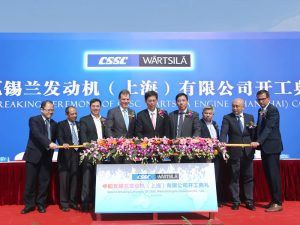
After the ground breaking ceremony, CWEC signed strategic cooperation agreements with the Hudong Zhonghua and Shanghai Waigaoqia (SWS) shipyards. It also signed a Letter of Intent ]with SWS for the delivery in 2017 of Wärtsilä Auxpac 32 generating sets for three large container vessels being built at the shipyard.

The CWEC joint venture was established in July 2014 for the manufacture of medium and large bore, medium speed, diesel and dual-fuel Wärtsilä engines. The new factory will be the first in China capable of producing locally large bore medium speed diesel and dual-fuel engines. By being able to produce and deliver locally, the new joint venture will provide CSSC Group and other Chinese shipyards with closer access to the Wärtsilä range of engines with the benefits of faster delivery times and competitive pricing. Wärtsilä’s share of the joint venture is 49 percent.

Products to be manufactured at the new facility will include the Wärtsilä 26, Wärtsilä 32, Wärtsilä 34DF, and Wärtsilä 46F engines, the first of which are expected to be ready for delivery in 2016. The production capacity is planned at 180 engines per year.

“It is an honor and a privilege to celebrate this latest milestone in our joint venture journey. By combining the strengths of our two companies; CSSC’s strong capabilities as the number one ship builder in China and Wärtsilä’s industry leading technologies, we can together make an important difference in today’s challenging global marine market,” said Roger Holm, Senior Vice President, Engines, Wärtsilä Marine Solutions.

This is an important occasion for the shipping industry in China. The new factory will produce state-of-the-art marine engines that will serve our customers with value adding efficiencies. We are pleased to cooperate with Wärtsilä in this exciting joint venture,” said Wu Qiang, President of CSSC.

The CWEC joint venture will target the offshore and LNG markets in particular, both of which are growing significantly in China. It will also serve the large container vessel segment.

CBO says Navy 2016 shipbuilding plan won’t work

Here’s how the CBO see things.

CBO says it estimates that the cost of the Navy’s 2016 shipbuilding plan—an average of about $20 billion  per year (adjusted for inflation) over 30 years—would be $4 billion higher than the funding that the Navy has received in recent decades.

The Department of Defense (DoD) submitted the Navy’s 2016 shipbuilding plan for fiscal years 2016 to 2045 in April 2015. The $20 billion total annual cost of carrying out the 2016 plan over the next 30 years, CBO estimates—would be one-third more than the amount the Navy has received in Congressional appropriations for shipbuilding in recent decades.

The Navy’s 2016 shipbuilding plan, says CBO, is similar to its 2015 plan with respect to the goal for the total number of battle force ships, the number and types of ships the Navy would purchase, and the funding proposed to implement its plans.

The Navy Plans to Expand the Fleet to 308 Battle Force Ships

The Navy’s 2016 shipbuilding plan states that the service’s goal (in military parlance, its requirement) is to have 308 battle force ships, consisting of aircraft carriers, submarines, surface combatants, amphibious ships, combat logistics ships, and some support ships. The 2016 shipbuilding plan falls short of the goals for some types of ships in some years, although generally the shortfalls are smaller than they have been in previous years’ plans. The fleet today numbers 273 ships.Under the 2016 plan, the Navy would buy a total of 264 ships over the 2016–2045 period: 218 combat ships and 46 combat logistics and support ships.

Given the rate at which the Navy plans to retire ships from the fleet, says CBO the 2016 plan would not meet the inventory goal of 308 ships until 2022, but it would allow the Navy to maintain its inventory at least at that level through 2031. After that, in most years through 2045, the fleet would fall below 308 ships.

The size of the Navy does not depend on ship construction alone; the length of time that particular ships remain in the fleet affects the force structure as well. The CBO notes that the Navy often shows flexibility in its approach to retiring ships: A ship may be retired before the end of its service life to save money or may be kept beyond that span to maintain a desired force level. Generally, the Navy’s estimates of expected service life align with historical experience.
However, the Navy currently assumes a 35- or 40-year service life for its large surface combatants; in the past, few of those ships were in the fleet for longer than 30 years.

CBO Estimates That Spending for New Ships in the Navy’s Plan Would Average $18.4 Billion per Year

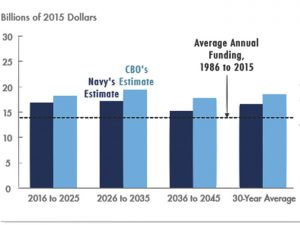
The Navy estimates that buying the new ships specified in the 2016 plan would cost $494 billion (in 2015 dollars) over 30 years—or an average of $16.5 billion per year—slightly less than the costs of the 2015 plan. Using its own models and assumptions, CBO estimates that the cost of new-ship construction in the Navy’s 2016 plan would total $552 billion over 30 years, or an average of $18.4 billion per year.

CBO’s estimates are higher because the Navy and CBO use different estimating methods and assumptions regarding future ships’ design and capabilities and treat growth in the costs of labor and materials for building ships differently.

CBO’s constant-dollar estimate is 8 percent higher than the Navy’s for the first 10 years of the plan, 12 percent higher for the following decade, and 17 percent higher for the final 10 years (see figure).

The difference widens over time in part because the Navy’s method of developing constant-dollar estimates (which differs from CBO’s method) does not account for the faster growth in the costs of labor and materials in the shipbuilding industry than in the economy as a whole and thus does not reflect the anticipated increase in inflation-adjusted costs of future purchases of ships with today’s capabilities.

Average Annual Costs of New-Ship Construction Under the Navy’s 2016 Plan

The Navy’s shipbuilding plan reports only the costs of new-ship construction.Other activities typically funded from the Navy’s budget accounts for ship construction—such as refueling nuclear-powered aircraft carriers or outfitting new ships with various small pieces of equipment after the ships are built and delivered—would add $1.7 billion to the Navy’s average annual shipbuilding costs under the 2016 plan, by CBO’s estimate. (Between 2010 and 2015, the cost of those other activities averaged $2.1 billion per year.) Including those extra costs would increase the average annual cost of the Navy’s 2016 plan to $20.2 billion per year, CBO estimates.

CBO’s estimate of the total cost of the Navy’s plan is 10 percent above the Navy’s estimate.

The Navy’s Shipbuilding Plan for the Next 30 Years Would Cost Almost One-Third More Than It Has Spent Over the Past 30 Years

If the Navy received the same amount of funding (in constant dollars) for new-ship construction in each of the next 30 years that it has received, on average, over the past three decades, the service would not be able to afford its 2016 plan.

CBO’s estimate of the $18.4 billion per year for new-ship construction in the Navy’s 2016 shipbuilding plan is 32 percent above the historical average annual funding of $13.9 billion (in 2015 dollars). And CBO’s estimate of $20.2 billion per year for the full cost of the plan is 28 percent higher than the $15.8 billion the Navy has spent, on average, annually over the past 30 years for all items in its shipbuilding accounts. If funding were to continue at the average for the past 30 years, under one possible approach to ship construction, the Navy would be able to build about 70 fewer battle force ships than it currently plans, CBO estimates.

Download the CBO report HERE

DSME reports more losses, but bail out looks likely

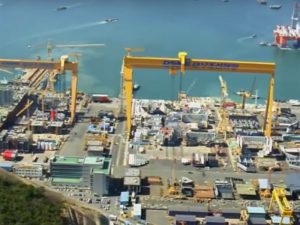
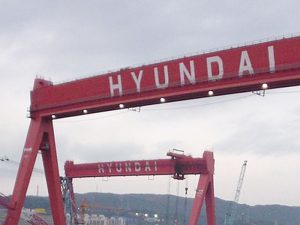
OCTOBER 27, 2015 — South Korean shipbuilding accountants must be buying red ink in 10 gallon jugs by now. After yesterday’s announcements of heavy losses by Hyundai Heavy Industries, today Daewoo Shipbuilding

Hyundai Heavy’s hurt continues


Both figures were far worse than analysts had predicted. 

On a quarter-on-quarter basis, sales declined 8.7%, while operating loss and net loss widened by 507.4 billion won and 209 billion won respectively, due to delays in offshore projects and lackluster sales by HHI’s construction equipment business. 

HHI said the rise in operating loss was attributable to early recognition of losses from contract cancellation of a semi-submersible rig; a loss provision for adverse changes in the offshore business environment such as the oil price decline; and an increase in the restructuring cost from divestiture of underperforming subsidiaries. 

A source said, “The shipbuilding business was hit by cancellation of a semi-submersible rig as oil prices nosedived to $40 a barrel. The offshore business set up a reserve for possible losses that may be incurred from belated change orders, increased manhours or delays in delivery caused by design changes.” 

HHI also booked the cost of liquidating unprofitable overseas subsidiaries, which started in 2014, as 3Q15 losses. 

A source in HHI said, “With a heavy focus on profitable businesses, HHI has taken bold steps to eliminate ailing subsidiaries since September 2014, as keeping them would only inflate the losses. The restructuring process is nearing its end, and part of the cost has been recognized as losses this quarter.” Meanwhile, HHI sees 4Q15 as a critical juncture for earnings turnaround. A source in HHI said, “4Q15 can be the starting point of earnings improvement: the shipbuilding business is recovering, with the phase-out of low-price orders and profit turnaround of commercial vessels. The offshore business has also booked all perceivable losses. Also, other businesses such as electro electric systems and engine and machinery have continued to cut costs.

“Even though the company has failed to turn a profit in 3Q15, it will spare no effort to normalize its operations, with a focus on profitable businesses, reshuffle for more responsible management of each business division, cost competitiveness enhancement, disposal of stock holdings and elimination of poor-performing subsidiaries to set the stage for a turnaround.” 

Time will tell.

Hyundai Heavy’s shares were down 2.3% at the end of trading in Seoul today

Fednav takes delivery of first BWTS equipped Laker

The ship, the 34,500 dwt ocean going laker Federal Biscay, is fitted with a ballast water treatment system (BWTS) — a first for ships transiting the Great Lakes, says Fednav, the largest international operator in the Great Lakes/Saint Lawrence Seaway System.

Fednav announced in April that it would equip all 12 ships in its Oshima shipyard newbuild program with BallastAce ballast water treatment systems (BWTS) (see earlier story).

Developed by JFE Engineering Corporation in Japan, the BallastAce system will be effective in both fresh and salt water. BallastAce operates through a combination of filtration and sodium hypochlorite (bleach) injection into the ship’s ballast system.

“This is a pivotal step in protecting the Great Lakes against invasive species and preserving biodiversity in the region,” said Paul Pathy, president and co-CEO of Fednav Limited. “Fednav is proud to be the first shipping company to deploy such systems, and we are pleased that the Federal Biscay is serving as a test ship for this technology.”

Fednav will start using BallastAce in the Great Lakes at the opening of the St. Lawrence Seaway in 2016.

With the assistance of Fednav, the BallastAce system (which is already USCG AMS approved) will continue the necessary testing for full U.S .Coast Guard type approval for fresh, brackish, and salt water at the GSI facility in Superior, WI, and at MERC in Baltimore, MD. During the first six months of 2016, the system installed on the Federal Biscay will be be used for the shipboard testing element of the type approval requirements.

Fednav expects that the IMO Ballast Water Management Convention, to which Canada is a signatory, will most likely enter into force in 2016, the year the U.S. Coast Guard and EPA require the installation of systems on ships trading in US waters.

LNG fuel tanks installed in first Crowley ConRo

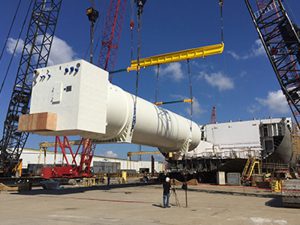
Another important milestone was marked last week, with the installation of three LNG fuel tanks in the first ship.

The double-walled, stainless steel tanks – which are 110 feet in length and 20.6 feet in diameter – weigh 225 metric tons and will hold more than enough LNG fuel for two round-trip voyages between the vessel’s future ports of call, Jacksonville, FL, and San Juan, Puerto Rico.

“While we are all excitedly watching these ships take shape, we are particularly proud of the role we, as a company, are playing to bring the most modern, technologically advanced and environmentally friendly ConRo ships in the world to the Jones Act market of Puerto Rico,” said Tom Crowley, company chairman and CEO. “There are no other ships of their kind being built anywhere else in the world today, and they are being constructed right here at home – in the United States of America. Having that shipbuilding capability here is essential to our national defense and an important reason we as a country need the Jones Act to be maintained and strengthened.”

Crowley’s two Jones Act ConRo ships, which will be named El Coquí (ko-kee) and Taíno (tahy-noh), are are scheduled for delivery second and fourth quarter 2017 respectively.

“It’s very impressive to see these new state-of-the-art Commitment Class ships take shape,” said John Hourihan, senior vice president and general manager, Puerto Rico services. “Seeing those LNG tanks being placed into El Coquí really resonates with me because we are setting a new standard for environmentally responsible shipping.”

The Commitment Class ships have been designed to maximize the carriage of 53-foot, 102-inch-wide containers, which offer the most cubic cargo capacity in the trade.

The ships will be 219.5 meters long, 32.3 meters wide , have a deep draft of 10 meters, and an approximate deadweight capacity of 26,500 metric tonnes. Cargo capacity will be approximately 2,400 TEUs (20-foot-equivalent-units), with additional space for nearly 400 vehicles in an enclosed Ro/Ro garage.

Each ship will be powered by an MAN B&W 8S70ME-GI8.2 main engine and three MAN 9L28/32DF auxiliary engines, all fueled by LNG .

The ship design is provided by Wartsila Ship Design in conjunction with Crowley subsidiary Jensen Maritime.

ceowleyLNG vert

LOAD MORE