Ingalls authenticates keel of Paul Ignatius (DDG 117)

The Aegis guided missile destroyer, Paul Ignatius (DDG 117). DDG 117 is the 31st ship in the Arleigh Burke (DDG 51) class of destroyers Ingalls is building for the U.S. Navy.

“The keel authentication is an important milestone in a ship’s life and it’s really a foundation upon which the ship is made,” said Ingalls Shipbuilding President Brian Cuccias. “Paul Ignatius epitomizes the leadership and agility that has propelled our nation forward – I couldn’t think of a better namesake for DDG 117. Over the coming years as we build this great ship, our shipbuilders know what we do is important. We are building great ships to defend our nation, to protect the brave men and women who will serve on this ship and come back safely home to their families.”

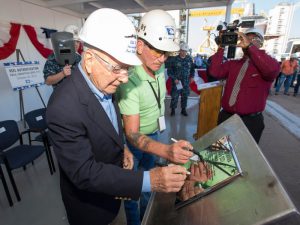
Ingalls welder Reginald Whisenhunt welded the initials of two authenticators — the ship’s namesake Paul Ignatius and 26-year shipbuilder Bill Jones, an Ingalls hull superintendent —onto a steel plate signifying the keel of DDG 117 to be “truly and fairly laid.”

The plate will remain affixed to the ship throughout the ship’s lifetime.

“It is a pleasure for me to be here with Huntington Ingalls officials and the men and women who are building DDG 117,” said Mr. Ignatius, whose wife, Nancy Ignatius, is the ship’s sponsor. “DDG 117 will become part of our country’s proud destroyer tradition. Built tougher than steel by one of America’s leading shipbuilders, constructed by dedicated and skilled shipyard technicians and manned eventually by the world’s finest naval officers and seamen, this new ship will sail for many decades into the future.”

“Every time the men and women of Ingalls craft another destroyer, they build a living, lasting remembrance of either the courage, the leadership or the intellectual contribution of the very best that the Navy and Marine Corps have to offer,” said Capt. Mark Vandroff, the Navy’s DDG 51 program manager.

Ingalls is building three other destroyers — John Finn (DDG 113), which is scheduled to be delivered in 2016, Ralph Johnson (DDG 114), which will launch by the end of the year and Delbert D. Black (DDG 119), which started construction in July.

To date, Ingalls has delivered 28 DDG 51 destroyers to the U.S. Navy. .
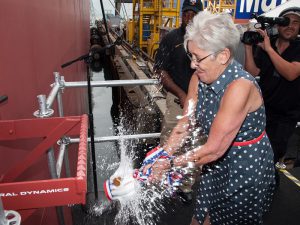
NASSCO christens first Kinder Morgan ECO tanker

San Diego Mayor Kevin Faulconer spoke at the ceremony, and the ship’s sponsor, Mrs. Helen Downs, christened the ship with the traditional breaking of a champagne bottle.


The ECO tanker, the Lone Star State, is the first of a five-tanker contract between NASSCO and APT, which calls for the design and construction of five 50,000 deadweight ton, LNG-conversion-ready product carriers with a 330,000 barrel cargo capacity. The 610-foot-long tankers are a new “ECO” design, offering improved fuel efficiency and the latest environmental protection features including a Ballast Water Treatment System.

The ships were designed by DSEC, a subsidiary of Daewoo Shipbuilding & Marine Engineering (DSME) of Busan, South Korea. The design incorporates improved fuel efficiency concepts through several features, including a G-series MAN ME slow-speed main engine and an optimized hull form. The tankers will also have dual-fuel-capable auxiliary engines and the ability to accommodate future installation of an LNG fuel system.

“Incorporating new and innovative green ship technology, these tankers are the future of American petroleum shipping. When delivered they will be among the most fuel-efficient and environmentally friendly tankers anywhere in the world,” said Kevin Graney, general manager and vice president for General Dynamics NASSCO.

“This christening ceremony is an important step forward for Kinder Morgan’s expanding fleet of Jones Act product tankers and demonstrates the strong demand for domestic waterborne transportation to move petroleum products and crude oil,” said Robert Kurz, vice president of Kinder Morgan Terminals and president of American Petroleum Tankers. “We look forward to taking delivery of this vessel next month and, along with our seven other operating tankers, providing first-class service to our growing customer base.”

In September 2014, Mayor Faulconer signaled the start of construction of the ECO tanker. In March 2015, San Diego’s First Lady and wife of Mayor Faulconer, Mrs. Katherine Faulconer, laid the keel.

“The Lone Star State is a great example of the kind of innovative technology being employed by NASSCO and our blue tech industry. Its construction has employed hundreds of San Diegans and helped sustain jobs for thousands more,” Mayor Faulconer said. “This ship is a symbol of the jobs and opportunities the maritime industry brings to our city.”

On Friday, October 16, NASSCO shipbuilders began construction on a fifth tanker for APT.

MAN Diesel & Turbo renews agreement with China’s CMP


CMP is an engine-manufacturing division of the Chinese State Shipbuilding Corporation (CSSC), one of the largest Chinese shipbuilders.

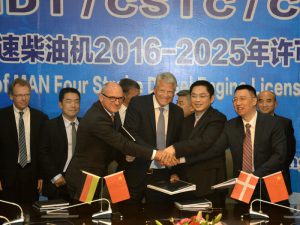
The new agreement, signed at a ceremony last week in Anqing, China, marks the renewal and continuation of a cooperation that first started in the 1980s.

“The extension of the four-stroke license agreement between CMP and MAN Diesel & Turbo is a tribute to the very first license we bonded 35 years ago,” said CMP Chairman Mr. Zhang Haisen. “Furthermore, the comprehensive cooperation scope refers not only to four-stroke diesel engines, but also to two-stroke low speed engines, CPP propellers, turbochargers, and SCR systems. CSSC values MAN Diesel & Turbo as its premium partner, and sincerely expects to continue this important business partnership to another 35-year milestone.”

“We have enjoyed a long, close cooperation with CSSC/CMP that stretches all the way back to 1980, and over the years CMP has produced a broad range of MAN four-stroke engines, but also small two-stroke engines,” said Klaus Engberg – Senior Vice President and Head of Two-Stroke Licensing, MAN Diesel & Turbo. “Especially over the last decade, our two companies have intensified their technical cooperation, making CMP today one of MAN Diesel & Turbo’s major licensees globally for such engines, and the largest producer of MAN four-stroke engines in China.”

Ulrich Vögtle – Vice President and Head of Large Bore Four-Stroke Licensing – said: “We view our relationship with CSSC as pivotal to our success in giving Chinese customers access to our technology. Accordingly, we are very happy and proud today to be able to officially announce the continuation of our excellent business relationship for the next decade.”

To date, CMP has delivered 5,000 units of MAN four-stroke diesel engines, equivalent to 4,700,000 kW. CMP also holds a license agreement for two-stroke MAN B&W engines, which it too renewed for a decade at a ceremony in Beijing earlier this year.

Headquartered in Beijing, CMP parent CSSC handles shipbuilding activities in the east and south of China and consists of various shipyards, equipment manufacturers, research institutes and shipbuilding-related companies. Some of the best-known shipbuilders in China, such as Jiangnan Shipyard and Hudong-Zhonghua Shipbuilding, are currently owned by CSSC.

Zhenjiang Marine Diesel (ZJMD), CMP’s predecessor, was founded in 1976 and signed a 15-year medium-speed licensing agreement with MAN Diesel & Turbo in May 1980. This was subsequently extended in 1995 and 2005.

Gladding-Hearn delivers new generation pilot launch

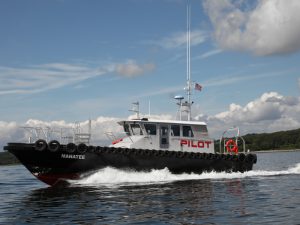
The 28 knot vessel is the association’s second Chesapeake Class launch and the first in a new generation of the popular, mid-size pilot boats.

The Somerset, MA, shipyard introduced the Chesapeake Class pilot boat in 2003.Since then, 15 have been delivered to pilot associations throughout the U.S.

The latest improvements incorporate the performance benefits of Volvo Penta’s IPS2 inboard propulsion system.

“The IPS2 system was created to improve the performance and the arrangement of planning hulls like our pilot boats,” said Peter Duclos, the shipyard’s president. “This new generation of Chesapeake launches, named Chesapeake Class MKII, is equipped with the IPS2 pods, which provide what pilots have been asking for: higher speeds, lower fuel consumption, and more comfort.”

With a deep-V hull designed by C. Raymond Hunt & Associates, the all-aluminum pilot boat measures 52.7 ft overall, with a 16.8-ft beam and a 4.5-ft draft.

It is powered by twin Volvo Penta D11, six cylinder, EPA Tier 3 diesel engines, each producing 503 bhp at 2,250 rpm. Each engine is connected to a Volvo Penta IPS propulsion pod, which is fitted with dual forward-facing, counter-rotating propellers and integrated exhaust system, and Volvo Penta’s integrated EPS electronic steering and control system.

The EPS control system and three-axis joystick increases the boat’s overall maneuverability alongside a ship and when docking, says Mr. Duclos.

The financial incentive for the Tampa Bay pilots to optimize fuel economy, vessel handling and comfort led the shipyard to install a Humphree Interceptor automatic trim- optimization system.

“The combination of the Volvo Penta IPS system and the Humphree interceptors gives the pilots higher speeds and improved comfort, while burning 25 percent less fuel than similar Chesapeake Class launches,” says Mr. Duclos.

Electrical requirements are met by a 9 kW Northern Lights generator.

Key design changes to the Chesapeake Class MKII include positioning the wheelhouse aft of amidships to improve comfort and provide for a larger foredeck.

With the pods close-coupled to the engines, the engine room is located well aft of the wheelhouse with easy access to machinery through a deck hatch.

This new generation of pilot boats is also designed to accept a gyro-stabilization system, designed to reduce vessel roll.

The wheelhouse, with forward-leaning windows, is outfitted with five Stidd seats and a settee and cooled by two 16,000 Btu air-conditioning units.

The forecastle, with a 12,000 Btu AC unit, has one berth and an enclosed head.Outside of the wheelhouse are wide side-decks and boarding platforms, port and starboard, on the foredeck.

At the transom is a winch-operated, rotating davit over a recessed platform for pilot rescues operations.

Carnival to bring two more cruise brands to China

Yesterday we reported that Norwegian Cruise line is to customize its second Breakway Plus newbuild for the Chinese market.

Today’s news is that Carnival Corporation & plc (NYSE/LSE: CCL; NYSE: CUK) is to deploy two additional cruise brands in China in 2017.

Carnival Cruise Line and AIDA Cruises will join Costa Cruises and Princess Cruises in the Chinese market, making Carnival Corporation the first company to operate four brands in China – which, it says, “is expected to eventually become the world’s largest cruise market based on surging demand for cruise vacations by Chinese travelers.”
 
The move means that four of Carnival’s ten brands will have at least one homeported cruise ship in China. The plan to deploy two additional ships – one new ship each for both its Carnival and AIDA brands – and operate four total brands in China in 2017 is in line with Carnival Corporation’s long-term, multi-brand strategy to provide Chinese travelers with a variety of vacation options and experiences to meet growing demand across all segments of the Chinese market.
 
“We are excited to introduce our Carnival Cruise Line and AIDA Cruises brands to our fleet in China, giving us a total of four global cruise brands in the market and a unique opportunity to provide a diverse lineup of brands and cruise offerings to Chinese guests who are looking for a great vacation experience,” said Carnival CEO Arnold Donald, who was in Shanghai to announce the news at the 10th Annual China Cruise Shipping and International Cruise Expo (CCS10). “As we execute our multi-brand growth strategy in China, we are emphasizing choice and variety in our offerings to match the different tastes and preferences of Chinese travelers.”
 
“As more and more Chinese are discovering why cruising is the best vacation experience, they are having a great time on our Costa and Princess brands, and we look forward to even more Chinese travelers enjoying vacations on our AIDA and Carnival brands,” said Mr. Donald. “This is an exciting time in China for the cruise industry, and as the world’s largest cruise company and the first global cruise operator in China, we are more committed than ever to helping China become one of the world’s most popular regions for cruise vacations.”

Adding the two new brands follows a July announcement by Carnival Corporation that Costa Cruises and Princess Cruises will  each put a new ship into its China fleet in 2016, making Carnival Corporation the first global cruise company with six total ships based in China. This all adds up to a 58 percent increase in total capacity in China in 2016, including three year-round ships and three seasonal ships in the market. Together, the Costa and Princess brands will potentially offer about four million passenger cruise days in 2016.
 
As previously reported, Carnival Corporation is also exploring potential joint ventures in China with China State Shipbuilding Corporation (CSSC) and China Merchants Group (CMG) designed to accelerate the growth of the overall cruise industry in China, including the possibility of launching a world-class Chinese domestic cruise brand, building new cruise ships in China, and supporting port and infrastructure development.

Cammell Laird to build $307 million polar research ship

The decision follows a 12-month competitive tender process that involved bids from shipyards in the U.K., Spain, Norway, Singapore and South Korea.

The Birkenhead shipyard is expected to cut steel in autumn 2016 and deliver the next generation polar research vessel ready for operation by 2019.

Cammell Laird Chief Executive John Syvret said: “The new contract, which will be finalized later this year, is expected to secure 400 jobs at Cammell Laird and a further 100 jobs within the local supply chain. Cammell Laird has a very successful apprenticeship scheme and would plan to recruit 60 apprentices throughout the term of the contract. Being selected as the preferred bidder in a global tender to undertake such an exciting and major infrastructure project is fantastic news for our workforce, the local region and the U.K. We look forward to helping the U.K. explore the depths of the ocean and push the boundaries of U.K. science.”

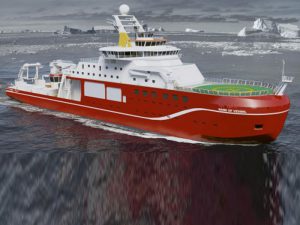
The new polar research ship, which will operate in both Antarctica and the Arctic, will be able to endure up to 60 days in sea-ice to enable scientists to gather more observations and data.

It is expected to have ice-breaking capabilities that will allow it to break ice up to one meter thick when traveling at 3 knots and will be able to accommodate up to 60 researchers and technical support staff.

The ship will be the first British-built polar research vessel with a heli-deck to open up new locations for science and will be one of the most sophisticated floating research laboratories operating in the Polar Regions.

Funding for the new polar research ship was announced in April 2014 as part of the U.K. Government’s science capital program.

Cammell Laird has been selected by the Natural Environment Research Council (NERC) through a full competitive procurement process.

NERC Chief Executive Professor Duncan Wingham said: “This new research ship, which is expected to become operational in 2019, will be equipped with onboard laboratory facilities and will be capable of deploying robotic technologies to monitor environmental changes to the polar oceans and will help U.K. scientists continue to lead the world in understanding our polar regions.

“Changes in both the Antarctic and Artic marine ecosystems affect the U.K.’s environment and economy, particularly in industries such as fishing and tourism. The Natural Environment Research Council funds polar research so that as a nation, we can develop policies to adapt to, mitigate or live with environmental change.

“This new polar ship will be a platform for a broad range of science, researching subjects from oceanography and marine ecology to geophysics.”

The new ice-strengthened ship will be operated by British Antarctic Survey (BAS), on behalf of NERC.

ABS offers guide for “SOx Scrubber Ready” ships


Instead, when ordering a newbuilding they may prefer to order a ship that is “SOx scrubber ready.”

Classification society ABS says that, Iin order to facilitate future modifications, ship buyers and shipbuilders must make a significant effort to figure out what features should be incorporated on a vessel and incorporate these in the shipbuilding contract.

To support shipowners taking this path, ABS has published the ABS Guide for SOx Scrubber Ready Vessels to support members and clients in preparing newbuilds for future outfitting with a SOx exhaust gas cleaning system (EGCS).

The guide supports the ABS classification notation for SOx Scrubber Ready Vessels by formalizing the process for clients who wish to plan for retrofit of a SOx scrubber at a future date by providing a detailed review and approval and an associated notation.

The SOx Scrubber Ready notation is in addition to ABS EGCS notations that may be assigned for vessels fitted with an exhaust emission abatement system, including SOx scrubbers, selective catalytic reduction systems and exhaust gas recirculation arrangements for NOx emission control, in accordance with the ABS Guide for Exhaust Emission Abatement.

More HERE and HERE


NNS switches its steam plant from HFO to gas

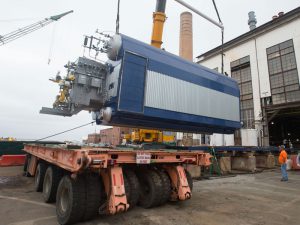
 The plant generates low-pressure steam to heat many of the shipyard’s facilities, to provide process heat and to support hotel services—including hot water, food preparation and galley services—to the ships undergoing construction and overhaul.

“We started researching and evaluating alternative options about four years ago with the goal of implementation by 2016,” said Bill Cash-Robertson, a Newport News Shipbuilding environmental engineer. “Not only does the conversion to natural gas make good business sense, it’s more efficient, it’s cleaner, and it’s safer to operate.”

The old system, which included three 70-year-old boilers, burned about 6 million gallons of heavy fuel oil last year, costing the shipyard about $15 million.

Plant Engineering Supervisor Ken Allmon, a member of the shipyard’s energy management team, said the new system will reduce greenhouse gases by 30 percent and save the shipyard several million dollars per year in lower utility costs.”The team is proud of our work to overcome technical challenges and implement a solution that is a win for everybody,” he said.

Will Koeck, the project’s construction engineer, said one challenge was to safely remove and install large boilers in a plant that had to continue operating during the conversion. “We met the challenge with careful coordination and planning, and we had the first new boiler in place making steam in December 2014,” he said.

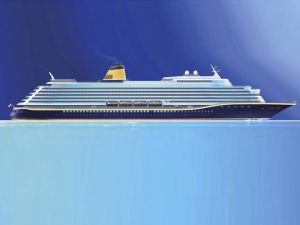
Saga Cruises orders 1,000 passenger newbuild at Meyer

The dock is presently used for block construction and by reopening it the shipyard will be able to deliver three cruise ships, including the Saga newbuild. The cruise line’s memorandum of agreement with Meyer has an option for a second vessel for 2021 delivery.

The Meyer Werft ship will be Saga Cruises’ first newbuild.  Catering for passengers in the 50+ age group, the cruise line currently has two ships, the 446-passenger Saga Pearl II and the 706-passenger Saga Sapphire, both built in 1981. According to Daily Telegraph, demand for sailings on the ships is extremely high: they carried around 25,000 passengers last year, with a 75 per cent repeat passenger rate.

The new ship will be 234 m long by 30.8 m wide and will have 540 cabins, all with balconies and with about 15% designed for passenger cruising solo.

“This is an important milestone in the future of Saga Cruises,” said the line’s CEO, Robin Shaw. “We are happy to develop this vessel, tailored to our individual needs, and we’re delighted to be working with Meyer Werft, a recognized leader in cruise ship construction.”

Bulker sea trials confirm benefits of Kappel FP propeller

The ships — the Elsabeth C and Mirela — feature single MAN B&W 5S60ME-C8.2 engines delivering 8,050 kW SMCR @ 89 rpm. They are owned by Frontmarine, an associate company of Lemissoler Navigation of Cyprus, and were

Lemissoler reports that the Kappel propeller offers significant fuel savings compared to conventional propellers and, together with the new vessels’ design and lines as well as the silyl acrylate antifouling paint, contributed to favorable results from the first two vessels’ sea trials. It reports that both vessels consumed an average 23 mtns per day at a speed of about 14.2 knots in ballast conditions during the trials. The Elsabeth C also performed a successful crash-stop test that was notable for its lack of noise and vibration.

Thomas Leander, Head of Propulsion – PrimeServ Four-Stroke – Denmark, said: “A key point during the design stage was to address the problem experienced by similar vessels that experience an overly-small light running margin (LRM). Therefore, MAN Diesel & Turbo recently introduced new light running margins for all FP propellers and two-stroke engines of 4-10%. Furthermore, the propeller layout for these 58,500-dwt vessels is 3-4% higher than normally applied to these vessel types. In doing so, MAN Diesel & Turbo has managed to ensure safe and reliable operation, while improving the vessel’s efficiency and maneuverability during its entire lifetime.”

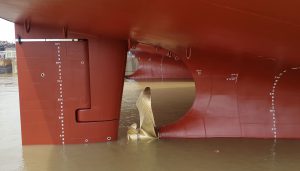
The MAN Alpha Kappel propeller was optimized out based on the stern and wake field for the newly designed 58,500-dwt vessel, with a 58,500-dwt stock propeller.

The Elsabeth C and Mirela were constructed by New Times Shipbuilding Co’s Jiangsu, China, shipyard . The remaining sisters are scheduled for delivery over the next 12 months.

lemisoler two 700

LOAD MORE