Green technologies: The road to faster adoption

Leading shipowners and operators, gas suppliers, ports, class societies, and technologists gathered last month in London to announce a new cross-industry initiative aimed at accelerating the adoption of Liquefied Natural Gas (LNG) as a marine fuel. The initiative hopes to address the issues of LNG bunkering infrastructure, regulatory concerns, and the higher initial capital investment costs in building LNG-fueled vessels.

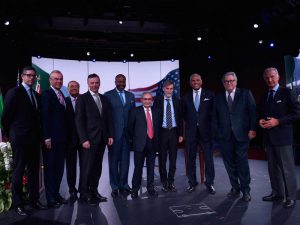
Called SEA/LNG, the initiative brings together participants from Carnival Corporation & plc, DNV GL, ENGIE, ENN, GE, GTT, Lloyd’s Register, Mitsubishi Corporation, NYK Line, Port of Rotterdam, Qatargas, Shell, TOTE Inc. and Wärtsilä.

The goal of the initiative explains TOTE Inc. Executive Vice President Peter Keller, who is serving as SEA\LNG’s Chairman, is to address “market barriers and help transform the use of LNG as a marine fuel into a global reality.”

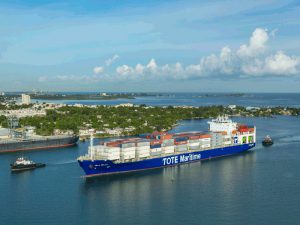
When it comes to using LNG as a marine fuel, TOTE is all in. It’s committed about $500 million in capital investments to have its entire fleet to burn LNG. The U.S.-flag operator has built two 3,100 TEU LNG-fuelled containerships now in operation between the Port of Jacksonville, FL, and San Juan, PR, and is converting the two ORCA Class Roll-on/Roll-Off ships in its fleet to burn LNG. The first of those two is being converted at Singapore’s Keppel Shipyard this fall.

TOTE is not alone in adding dual-fuel and LNG-Ready tonnage to its oceangoing fleet in the U.S. Harvey Gulf International Marine, Crowley Maritime Corp., Matson Navigation, Kinder Morgan, and SEA VISTA/SEACOR all have vessels in operation or under construction that burn or could eventually burn LNG as a marine fuel. In all, there are 29 vessels that are designed or could be converted to burn LNG as shown in the accompanying table. This does not include inland and coastal vessels such as towboats or ferries.

The U.S. Maritime Administration, for example, is supporting the conversion of a towboat to burn LNG as fuel.

The use of LNG as a marine fuel has increased with Emission Control Areas (ECAs) coming into force in Northern Europe and North America under MARPOL Annex VI. LNG is relatively clean burning, containing virtually no sulfur content and it produces lower NOx and particulate matter in the combustion process than fuel oil and marine diesel oil.

A long-time, well-known proponent of LNG as a marine fuel, John Hatley, PE, Gas Initiatives Wärtsilä North America, sees gas as a compelling solution for box feeders, RO/RO vessels, ferries and cruise ships, product tankers, Great Lakes vessels, and ATBs on short coastal voyages that enter into ECAs.

LNG is therefore able to offer a fuel solution compliant with both current and anticipated future regulations.

The larger effect from Annex VI will come when the requirement to reduce sulfur content of marine fuels to 0.5% on a global basis effective 2020 or 2025 depending on the outcome of an IMO low sulfur fuel availability study to be completed in 2018. The issue for ship owners and operators is how to find alternatives to economically meet the low sulfur fuel mandate about to be imposed by MARPOL Annex VI.

However, while LNG is a competitive fuel relative to current alternatives, LNG infrastructure is needed in ports around the world to enable quick, safe and cost effective bunkering. In the U.S., the first LNG bunker transport barge with GTT Mark III Flex tank technology is under construction at Conrad Orange shipyard in Orange, TX, and expected to be delivered in early 2017. LNG bunkering infrastructure is far more advanced in Europe.

“Everybody is calling for alternatives to reduce environmental impacts says Philip Olivier, CEO of ENGIE Global LNG. “That’s why we have joined forces to actively promote LNG as a key fuel in maritime transport. LNG has the potential to take a 10% market share of global bunker demand by 2030. ENGIE will contribute to achieving this target.”

Tom Strang, Senior Vice President, Maritime Affairs, Carnival Corporation & plc, says, “By working together proactively across the whole marine LNG value chain we can make the transition to a lower emission marine sector a reality.”

Lauran Wetemans Shell’s general manager downstream LNG agrees. “To make the transition to LNG as a fuel happen it needs close collaboration with key players across the full value chain,” says, Wetemans. “SEA/LNG aims to promote the benefits and potential of LNG fuel, and create a level playing field for LNG with other fuels. It will complement the work being done by other organizations like the Society for Gas as a Marine Fuel.”

Leo Karistios, Gas Technology Lead, Lloyd’s Register, points out, “LNG fuelled shipping has mainly been for the visionaries and, until now, concentrated in specialist ship sectors: short sea shipping and ferries, mainly sailing between two fixed ports. We want to help drive the expansion of LNG as a marine fuel of choice, with not just more short sea and local ships burning gas, but also the deep sea trades.”

Timo Koponen, Vice President, Flow & Gas Solutions, Wärtsilä Marine Solutions, says his company will contribute “its vast experience and know-how in gas driven propulsion systems and the entire gas value chain” to the initiative. “By working together, we plan to overcome the challenges and speed the general acceptance of LNG. Having been a pioneer in the use of LNG as a marine fuel, and a developer of major technologies facilitating the adoption of LNG fuel, it is natural that Wärtsilä supports wholeheartedly the aims of the SEA/LNG coalition.”

Developing bulk carrier concept
Wärtsilä is also involved with an effort with class society ABS, Arista Shipping, Deltamarin, and GTT in the Project Forward joint development project (JDP) to develop a dry bulk carrier concept that employs LNG as fuel.

The goal is to develop a Kamsarmax bulk carrier design to be the first of this type suitable for worldwide services powered by LNG in compliance with the IMO’s Energy Efficiency Design Index 2025 standards, NOx Tier III and MARPOL Annex VI SOx emission levels. This landmark design will be the first LNG-fueled cargo ship capable of full-range operations.

“The long-term potential for LNG as a marine fuel is tremendous,” says ABS Vice President of Global Gas Solutions Patrick Janssens. “We see the near-term opportunities for larger vessels on fixed and known trade routes, but more opportunities will emerge as concepts mature and bunkering infrastructure expands. Environmental stewardship will continue to be a concern, and owners will be evaluating alternative fuel choices.”

“Project Forward represents a milestone for the shipping industry in bringing to the market a practical, achievable design for what are the workhorses of the shipping fleet,” says Arista Shipping Principal Alexander P. Panagopulos. “Our mission is to develop the next generation of energy efficient and environmentally friendly dry bulk cargo ships to be sustainable worldwide beyond 2030. It marks a number of ‘firsts’ and draws together the experience of a team of leaders in their field to make LNG powered shipping a reality on the high seas.”

Technical challenges in developing this design were considerable, as there is a need to carry a large volume of LNG (2,500 m3) – which corresponds to full-range operation and 40 days – in a type of ship where available space is limited and cargo space is at a premium.

ABS will provide Approval in Principle (AIP) for the concept, which is based on the highly optimized Deltamarin B.Delta 82 design, utilizing a GTT membrane LNG fuel tank. This design also could be applied to other bulk carrier sizes and serve as the basis for an LNG-fueled tanker. The concept features a Wärtsilä four-stroke, medium-speed engine without auxiliary generators, the first time this configuration has been applied to a vessel of this type, significantly simplifying the vessel’s engine room arrangement and contributing to lower capital expenditure.

Read more from our Green Technology & Sustainable Shipping section in our Digital Edition.
Carnival releases latest sustainability report

AUGUST 4, 2016 — Carnival Corporation & plc (NYSE/LSE: CCL; NYSE: CUK) has released its 2015 sustainability report detailing the progress made in 2015 against its 2020 sustainability performance goals. In 2015,

Carnival orders five worth $3.42 billion at Fincantieri

APRIL 4, 2016 — Carnival Corporation & plc (NYSE/LSE: CCL; NYSE: CUK) has finalized contracts with Italian shipbuilder Fincantieri S.p.A. to build five new cruise ships as part of a memorandum of

Carnival gets nod to start cruises to Cuba on May 1

MARCH 21, 2016 — Carnival Corporation & plc, (NYSE/LSE: CCL; NYSE: CUK) reports that Cuba has granted approval for the company to begin travel to Cuba starting on May 1, 2016. Following

Cruise Shipping: Travel with a purpose

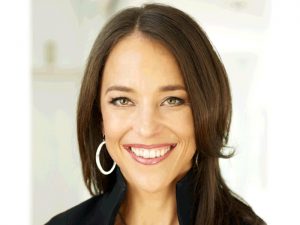
Visionary, consistent, and determined—these adjectives are just some of the many that can be used to describe Tara Russell, Founder and President of Fathom, a new cruise brand launched under the Carnival Corporation & plc umbrella. What makes Fathom unique is its mission of providing a new kind of cruising experience to those on board—what it calls “social impact travel.”

From its logo to its leader, Fathom is a brand with its heart set on cruising with a well-intended purpose: Making the world a better place.  Russell, for her part, has years of practice in leading the way for social change. Throughout her 20 years of working in both the global and private sector—she’s worked for Nike, Intel and General Motors—Russell has founded (or co-founded) a number of organizations meant to make the world (and its people) better.

Before joining Carnival Corporation, she founded and served as CEO of Create Common Good, a non-profit that puts “love in action,” by providing foodservice job training and job placement assistance to those with difficulties in finding employment—this enables the individual to become self-sufficient and financially independent.

Prior to that, she co-founded Jitasa, a global social venture that provides financial services, predominately accounting and bookkeeping services, to the non-profit industry.

She also worked in Thailand for four years offering pro bono small business development training to non-governmental organizations (NGOs). During her stay in the country, she co-founded NightLight, an international organization that addresses the complex issues surrounding human trafficking and prostitution—this included helping women seek freedom from sexual exploitation in Thailand where a large number of the world’s sex trade takes place.

According to the U.S. Department of State’s 2015 Trafficking in Persons Report, there are “an estimated three to four million migrant workers in Thailand, most from Thailand’s neighboring countries.” Meanwhile, “Sex trafficking remains a significant problem in Thailand’s extensive sex trade—often in business establishments that cater to demand for commercial sex.” NightLight offers an outreach program of sorts, where it helps build support networks, provides intervention and assistance to those in need; and offers alternative job opportunities, training, and physical, spiritual and emotional development.

As for her approach and transition to Fathom, Russell explains, “Having worked in both the private sector at Fortune 50 companies and in the non-profit social impact space, I saw a real opportunity to bring the two together to create [an] authentic and enduring social impact.”

She adds, “The business leaders at Carnival Corporation shared my vision. So we worked together to find ways to harness the resources of the world’s largest cruise line and combine [it] with the talents and hearts of those working with social entities.”

The wheels started turning for Fathom during the summer of 2013 when CEO of Carnival Corporation Arnold Donald and Russell met. “The executive leadership of Carnival Corporation had been eager to find ways (where possible) to harness the scope and scale of the company’s global resources for social impact,” explains Russell. “As such, Carnival Corporation had been exploring unique opportunities—both tailored to individual brands and beyond—to integrate social impact into its operations.”

After their meeting in 2013, Russell and Donald spent the better part of 2014 “building the vision, designing the product, developing the impact travel concept, and testing and sizing the market.”

“Fathom’s vision,” explains Russell, is to “harness and leverage Carnival Corporation’s assets for the greatest possible transformative impact, globally. We will send 704 travelers on every trip—thousands of travelers a year—to communities in need, providing tremendous scale that will sustain several ongoing programs.

“This continuity of support—different travelers going to the same community on a regular basis—is what will make a major difference in the lives of people and communities,” adds Russell.

Going in deep
When Fathom was launched in June 2015, Carnival specifically chose the United Palace Theater in the Washington Heights area of Manhattan, NY, to announce the new brand to the world.

The setting for the launch was apropos as it was announced then that the Dominican Republic would be the first destination for Fathom’s impact travel. Washington Heights is a predominately Dominican neighborhood, with most of its residents moving to the area directly from the Dominican Republic.

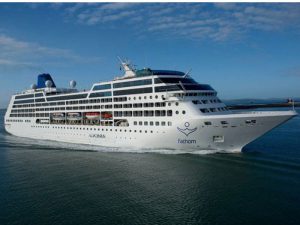
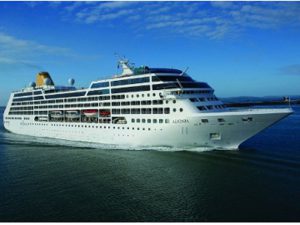
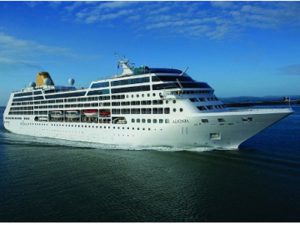
AdoniaThe brand’s ship, the 704-passenger Adonia, will make its first trip to the Dominican Republic this coming April. Prior to joining Fathom, the 592 ft Adonia was the smallest ship in the P&O fleet. P&O is also a part of the Carnival Corporation brand.

Why the Dominican Republic? Fathom says that while the country is stunningly beautiful, it’s also a country very much in need. According to the U.S. Central Intelligence Agency’s (CIA) “The World Factbook,” 41.1% of the population in the Dominican Republic is living under the poverty line.

Fathom notes that the average household income is approximately $6,000 a year, more than three million Dominicans have no access to piped water, and education is incredibly underfunded—thus perpetuating the cycle of poverty with each new generation.

To see how Fathom could help, Russell explains that she and Donald met with “key Dominican Republic community leaders to understand the need and how best to leverage the existing infrastructure of local organizations to become involved in creating enduring impact in our first destination market.”

Among these key community leaders are Fathom’s “lead impact partners,” Entrena and the Instituto Dominicano de Desarrollo Integral, Inc. (IDDI). Entrena and IDDI helped Fathom “understand the specific needs in the northern region of the country and identified the areas of most need where Fathom travelers could provide meaningful, long-term and sustainable impact,” says Russell.

“We then collaborated with them to develop detailed projections regarding the scale of impact we intend to create together with our partners, our travelers and our communities.”

Entrena and IDDI are both already established organizations in the Dominican Republic. Entrena specializes in training, education and social entrepreneurship. Meanwhile IDDI’s primary objective is to contribute to the transformation of the human being, families and communities, so that they can live a productive and healthy life.

By partnering with entities such as these—that already have a system and structure in place—Fathom ensures that its travelers (the term it uses for its passengers) will be working within programs that are already making a difference in the region—and that the work will be continuous throughout the year—even as the travelers are different every week.

fathom chocalchocolatefactory hiresFathom’s impact travel to the Dominican Republic is a seven-day experience, with three days working on the island.

Upon reaching the Dominican Republic, Fathom travelers will be immersed in a variety of projects—operated by Fathom’s local impact partners—focused on economic development, education and the environment.

Travelers will participate in activities such as supporting the reforestation efforts in the region, cultivating cacao plants, supporting local youths learn/practice English, and assisting local women’s cooperative in producing artisan chocolates—just to name a few.

Fathom projects that its impact travel work with its partners, travelers and communities could lead to higher English proficiency through Student English Learning—this will help with employment opportunities; greater access to high-quality recreational enrichment activities for students during the school day; an increase in local entrepreneurship; the planting of 20,000+ trees which will lead to more nutrient rich soil and higher agricultural yields; and access to cleaner water, with the production of ceramic water filters—5,000+ filters are expected to be generated each year.

The route to Cuba
Shortly after Fathom’s launch, it was announced that the brand named its second destination: Cuba.

The U.S. Department of the Treasury granted approval to Carnival Corporation back in July. Since then, Carnival has been in active discussions with the Cuban government, according to Russell.

Cuba has been closed off to U.S. travelers by sea for more than half a century. And while a number of operators are jumping on the Cuba (mostly ferry) bandwagon—Fathom promises an entirely soul-enriching experience for both its travelers and the Cuban people.

“The overarching objective of our visiting Cuba will be to connect to the heritage of that country through an immersive program that encourages cultural, artistic, and faith-based exchanges between American and Cuban citizens,” says Russell.

“In Cuba, the focus of our travel is defined by the Cuban Assets Control Regulations and authorized American travelers must engage in Cultural, artistic, religious and humanitarian exchanges with the Cuban people. There, we will collaborate with approved licensees or General licensees on initial itinerary development to ensure proper compliance is programmed and maintained throughout each voyage,” explains Russell.

According to Fathom, the itinerary in Cuba will include “diverse on-the-ground immersion experiences,” with activities including “engaging artists, experiencing the local food and music culture, meeting local Cuban business professionals, understanding micro-enterprise and the agricultural sector, connecting to the education system and youth.”

Pending approval from the Cuban government, Fathom could set out to Cuba as early as this May.

What comes next?
When asked what countries Fathom has next on its agenda, Russell says the goal for now is to focus on its work in the Dominican Republic and Cuba, ensure success in the regions, and establish long-term partners in each country.

Wherever Fathom goes, however, the goal will be the same: to leave that place and its people, better off.

Fathomlogo“Ten years from now,” says Russell, “I’d love to believe that we have helped eradicate unemployment in the Dominican Republic and in many of the places that we visit. I want to believe we have helped to give children and youth the tools to fall in love with education, have helped to improve the environment and health outcomes that have been a part of making people generally healthier. My hope and intent is that the locations we [Fathom] travel to, flourish.”
Fathom is a cruise line intent on changing the world—its led by a woman who wears her heart on her sleeve, and is supported by a parent company that wants to have a positive impact on the global community. Fathom proves its purpose through its promises, through its partnerships and its actions. Even its logo is a reminder of its intention, take a glance at it and you’ll see what Fathom is all about—it “signifies open arms that embrace the world and serves as a reminder that the Fathom brand stands for love in action and transformative travel,” asserts Russell.

To join the movement and help create positive impact, visit www.fathom.org


Fathom names Ron Fenska VP Sales

JANUARY 7, 2016 — Carnival Corporation’s newest cruise brand, Fathom, has appointed Ron Fenska as its vice president of sales. He will be responsible for leading the brand’s overall sales strategies and

Carnival inks four cruise ship agreement with Fincantieri

DECEMBER 30, 2015 — Carnival Corporation & plc (NYSE/LSE: CCL; NYSE: CUK) reports that it has signed a memo of agreement with Italian shipbuilder Fincantieri S.p.A. to build four new cruise ships

Azipods ordered for two more Carnival Corp. newbuilds

ABB’s delivery will also include generators, main switchboards, a remote control system and distribution transformers.

One of the ships is for Carnival Corporation’s Holland America Line brand and will 99,500 gt, 2,650 passenger sister ship to Koningsdam, currently under construction at the Fincantieri shipyard. It will be delivered in fourth quarter 2018.The other is Carnival Cruise Line’s 3,954-passenger a sister ship to Carnival Vista. It is set for delivery for in first quarter 2018 and will be the line’s twenty-sixth ship

“We are pleased to continue our collaboration with Fincantieri, which is known as one of the world’s leading cruise ship builders. Longstanding customer relationships with leading shipyards such as Fincantieri are testament to our continued dedication to quality and customer value,” says Heikki Soljama, managing director for ABB’s Marine and Ports business.

The collaboration between ABB and Fincantieri spans over 25 years: ABB’s first electric propulsion delivery to Fincantieri was for a Carnival cruise ship in 1990. Since then, 14 ships built by Fincantieri have been equipped with ABB’s Azipod propulsion. Twenty-four of Carnival Corporation’s ships are equipped with Azipod propulsion.

Costa to build two 6,600 guest LNG fueled cruise ships

JULY 28, 2015 — Costa Cruises is to build two 6,600 guest, LNG fueled cruise ships under the four ship newbuild program at Meyer Werft announced by Carnival Corporation & plc (NYSE/LSE:

Carnival gets U.S. approval for travel to Cuba

JULY 7, 2015 — Carnival Corporation & plc (NYSE/LSE: CCL; NYSE: CUK) today reported that the U.S. Department of the Treasury and the U.S. Department of Commerce have granted approval for the

LOAD MORE