Marine Log
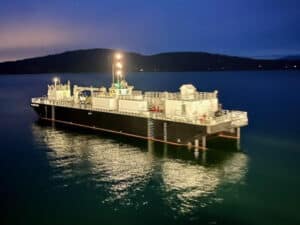
JUNE 3, 2013 — Shipbuilder Senesco Marine of North Kingstown, RI, last month launched the largest commercial floating dry dock in the Northeast United States. Built for Caddell Dry Dock and Repair Co. of Staten Island, NY, the dry dock has a lifting capacity of 7,300 LT, is 420 feet long, and has a 100 foot wide open pontoon deck between its 30 foot tall wing walls.
JMS Naval Architects (JMS) of Mystic, CT, designed the dry dock for Caddell to accommodate large tank barges, tugs, workboats and Coast Guard Cutters.
The dock is segregated into eight pairs of compartments with a safety deck 12 feet above the pontoon deck. The design incorporates large, side openings through the wing walls to allow machinery and personnel access to the pontoon deck. The pumping and electrical systems are designed to match Caddell's six other dry docks to simplify dock operations.
Senesco recently completed extensive modifications to its waterfront facilities in order to launch the dry dock via air bags and to add the capability of performing air bag launches for future large vessel construction and launch projects.


JUNE 10, 2013 — Bunker barges able to deliver LNG in the volumes required by large oceangoing ships have been seen as a limiting factor in the development of LNG as a marine fuel. According to Vear, Norway, headquartered NLI Solutions, only one LNG bunkering barge exists, capable of delivering 187 cu.m. of LNG, compared to the several thousand cu.m needed by oceangoing ships.
Now NLI Solutions has developed a concept for a 4,000 cu.m LNG bunker barge. It is based around NLI's own LNG tank design and has been further developed in a design study together with the Marine division of Rolls-Royce and Wilhelmsen Technical Solutions (WTS).
"Building a small carrier for bunker purposes is expensive so our suggestion is a high-tech low cost barge, the HighTechBarge (HTB)," says NLI Solutions.
The HTB will for safety reasons be very maneuverable with pod-drives, as is used in offshore support vessels, have state-of-the-art electronics for danger detection and early evasive maneuvering.
The NLI LNG tank is an atmospheric, prismatic steel tank, type "B", in this study capable of containing 4,000 cu.m of LNG. It will be covered with a new insulation system with very low levels of boil off gas (BOG).
As re-condensation equipment is expensive, takes a lot of space, and has a low efficiency for small installations, the BOG that is produced will be used to fuel the barge's own engine and produce electrical power for both propulsion and all barge and LNG/gas systems. is of course from a clean burning gas engine.
The HTB has a large pressure tank on the aft deck for BOG handling and gas delivery to engine. If the HTB has long periods without activity (bunker customers), excess BOG can be delivered to a shore side gas grid, or the barge can deliver electric power to a shore side electric grid.
The study has been carried out and planned with:
Rolls-Royce NVC, responsible for design, Bergen gas engine, pod drives and bridge systems
TI Marine Contracting (part of WTS) responsible for insulation systems
NLI responsible for tank, LNG/gas systems, bunkering systems
The design challenges existing class regulations and codes, and DNV has participated in looking at limitations and possibilities in this area.
High-Tech LNG Bunker Barge - HTB
LOA 63 m
B MAX 20 m,
DEADWEIGHT abt. 2,000 T
Service speed 8 knots
LNG tank capacity 4,000 cu.m,
CNG tank for compressed BOG 270 cu.m
Aft deck contains compressors, vaporizers etc. Bunkering operations from tank top. Main engine and gen-set, size pending operation: Bergen C26:33 gas engine; Bergen C gas engines are available with powers from 1,440 kW to 2,430 kW.

FEBRUARY 1, 2013—Florida Marine Transporters, Inc., Mandeville, LA, recently exercised options to build at least one and up to five additional 90 ft x 32 ft x10 ft “Canal Class” inland towboats at Eastern Shipbuilding Group, Panama City, FL.
Last December, Florida Marine Transporters (FMT) took delivery of the M/V Blake Boyd , the fifty-fifth towboat built by Eastern for FMT. This series of towboats originally began with a 25-vessel contract, with deliveries starting in 2006 and has expanded to become the largest single towboat design/build contract. This new contract is for one towboat with four options and will be constructed from a design furnished by Gilbert Associates, Inc. of Boston, MA.
The new towboat under this contract will be the first in this series with EPA Tier 3-compliant main propulsion engines and generators. Louisiana Power Systems Is supplying the main engines will be two Caterpillar 3512C Tier 3 diesels rated at 1,500 hp at 1,600 rev/min. The reduction gears are direct-coupled Twin-Disc Model MG-5600 with a 6.04:1 reduction supplied by Stewart Supply, Inc., Harvey, LA. Electrical power is provided by two 99kW John Deere 4045AFM85 99KW Tier 3 generator sets rated for 60 Hz, at 208 VAC provided by Kennedy Engine Company, Biloxi, MS. These diesel engines comply with the current EPA/MARPOL control of emissions of nitrogen oxides from marine diesel engines.
Thirteen years ago, FMT set on a course of achieving excellence in the maritime industry as envisioned by its CEO Dennis Pasentine. Together with committed shipmates and a strong work ethic, FMT has developed into one of the largest inland marine companies, with one of the youngest towboat and tank barge fleets. FMT transports a variety of cargoes such as petrochemicals, chemicals, LPG, crude oil, agricultural liquids and dry cargo.
FEBRUARY 8, 2012 — Damen Shiprepair Brest, France, continues to recover market share in the LNG repair business, following Damen's acquisition of the former Sobrena, just under a year ago.
The shipyard has been well respected for its LNG expertise and is getting another opportunity to demonstrate it with the arrival this month of the 89,880 cu.m, Teekay owned and managed Arctic Spirit.
The ship which is scheduled to stay in the Brest shipyard for three weeks, is one of the few LNG carriers with an IHI SPB Prismatic Tank Cargo Containment System, which makes it a somewhat special and highly complex vessel.
Damen Shiprepair Brest Managing Director, Jos Goris comments: "We are very pleased and proud that an industry major such as Teekay has proven confidence in our yard."
Late last year, Shell and Hyproc also chose to drydock LNG carriers at the yard.
Able to carry out drydocking, refit and repair works, Damen Brest is determined to become a reliable and long-term business partner for the LNG community.
"We have a very clear and open business concept which is built on transparency, mutual trust and customer service. In the current challenging climate we understand that our clients need to perform more than ever and the selection of the right shipyard plays an important role in being successful," says Mr Goris.
In the past the shipyard carried out more than 100 LNG carrier refit projects. Damen Shiprepair Brest is confident that it can continue to show the LNG community that the shipyard has the expertise and experience needed to serve this specialist sector.
The closure of the then Sobrena in September 2011 meant there was little competition in the Northwest European region for LNG drydocking and repair. However, says Mr. Goris, most LNG carrier owners and managers trading in the region have indicated that they are willing to support fresh alternatives.
"We are very confident that the LNG community will support us with more bookings and at sustainable price levels," says Mr. Goris.
"Damen Shiprepair Brest is very keen to bring healthy competition to the market again," he says. "We are aware that there is some heavy discounting going on, but would question whether such low rates will benefit the LNG sector in the long-term."
During the first nine months of operations as part of the Damen Shipyards Group, Damen Shiprepair Brest has serviced more than 40 vessels from majors such as Knutsen, Odfjell, Hyproc, STASCO, Columbia Ship Management, Louis Dreyfus Armateurs, Northern Marine Management, Wallem, Bourbon and CMA-CGM.
Damen Shiprepair Brest offers a broad range of services to key markets and for any vessel type, including LNG tankers, oil tankers, semi-submersibles, shuttle tankers, FPSO's, offshore construction vessels, jack-up rigs, ro-ro vessels and ferries.
The well-established repair yard has modern facilities and three graving docks, as well as several repair berths. The largest dry dock measures 420 m x 80 m and is one of the biggest in Europe, allowing the yard to accommodate almost any vessel in the world. The highly skilled workforce numbers 220 people.
JUNE 4, 2013 — Rolls-Royce Plc has signed a memorandum of understanding with Spanish shipping company Baleària, to design gas-powered propulsion systems for three of the company's high-speed ferries, which currently run on diesel.
They are the the monohull HSC Ramon Llull, delivered by Italian shipbuilder Rodriquez Cantieri Navali SpA in 2003, the catamaran HSC Jaume II, originally delivered as Condor 12 in 1996 by Incat Tasmania and the catamaran HSC Jaume III, delivered by Incat in 1997 as Holyman Express
Baleària, which operates ferry services between the Spanish mainland and the Balearic Islands, in the Strait of Gibraltar and The Bahamas Islands, is proposing the conversion of the three ferries from diesel to liquefied natural gas (LNG).
Adolfo Utor, the Baleària Chief Executive Officer said: "This is a strategic agreement for the future of the company. The change in fuels will allow us to have high-speed, more competitive vessels available and, at the same time, be more respectful towards the environment, given that this fuel reduces CO2 emissions by 25 percent."
Neil Gilliver, Rolls-Royce, President - Merchant said: "There is no doubt that popularity of LNG as a marine fuel is increasing, as stricter emission controls and higher fuel costs continue to drive the strategic decisions of shipping companies. This is our first LNG project in Spain, which joins a growing list of countries where operators are keen to investigate the potential applications for a marine fuel that will reduce emissions and reduce operating costs."
"We are delighted to be working with Baleària on this project which demonstrates that LNG is now a serious option for converting existing fleets, as well as for newbuilds."
Rolls-Royce is a leading supplier of LNG propulsion systems, and its range of Bergen gas engines are the only pure gas engines on the market. The Baleària project will involve developing an economic and technical proposal to convert the three ferries to LNG power.
Rolls-Royce will work with Baleària on developing efficient propulsion systems for the vessels which are a mix of catamaran and monohull design, with water jet propulsion.
Spanish company Cotenaval will lead the naval architecture aspects of the conversions.
More Articles...
Page 18 of 49