Marine Log

USCG continues response to tug and barge pipeline allision

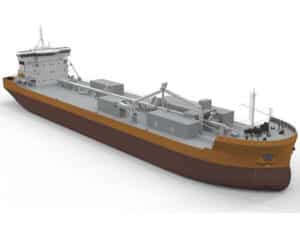
blaze3 USCG-PHOTOMARCH 14, 2013 — The Coast Guard reported today that response operations continue for a tug and barge that allided with a pipeline near Bayou Perot 30 miles south of New Orleans Thursday (see earlier report).

The Coast Guard is conducting a full investigation of the incident to determine the cause of the incident. No conclusions have been drawn at this time.

Personnel from T&T Salvage aboard the Todd Michael spud barge are on scene for cooling operations of the tank barge. The fire remains stabilized.

Responders continue to monitor and ensure the integrity of the barge is maintained to allow for safe salvage operations as soon as the fire is extinguished.

The Coast Guard has placed temporary flight restrictions over the airspace near the Shannon E. Settoon barge at and below 5,000 feet within approximately a one-mile radius. Responders have deployed 10,400 feet of boom around the tank barge to contain any possible pollution risks.

A Coast Guard Air Station New Orleans MH-65 Dolphin helicopter crew is currently conducting an overflight assessment of the pipeline fire and is reporting the condition of the tug and barge to the unified command.

Approximately 2,200 barrels of crude oil remain on board the barge and have not been compromised.

There are approximately 40 response personnel on scene.

Resources deployed for the incident:

The 160-foot Coast Guard Cutter Axe and crew;

Twenty-thousand feet of containment boom on scene;

Two Marco skimmers;

Ten response vessels;

Two oil spill response trailers.

The unified command consists of the U.S. Coast Guard, Louisiana Oil Spill Coordinator's Office, Settoon Towing and Chevron. Contracting organizations include ES&H, CTEC Air Monitoring, T&T Salvage and Resolve Marine.


Wärtsilä wins Viking Grace maintenance agreement

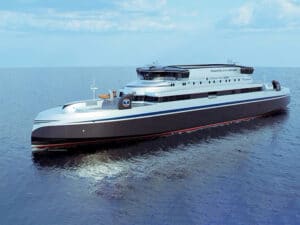
viking graceMARCH 14, 2013 — Wärtsilä has signed a five year maintenance agreement with Finnish shipowner Viking Line. The agreement, which became effective from March 1, is for maintaining and servicing of Wärtsilä equipment in the Viking Grace, the largest passenger ferry thus far to operate on liquefied natural gas (LNG) fuel.

The Viking Grace operates a regular timetable schedule in the Baltic Sea between Turku in Finland and Stockholm, Sweden. It is designed to carry cars, trucks and road trailers, as well as 2,800 passengers and 200 crew members. By operating on LNG fueled Wärtsilä DF engines, the vessel can sail without restrictions in Sulfur Emissions Control Areas (SECAs) and upcoming Nitrogen Emissions Control Areas (NECAs).

The agreement covers the ship's four Wärtsilä 50DF dual-fuel main engines, as well as the Wärtsilä LNGPac gas system's safety valves. Under the terms of the contract, Wärtsilä will provide a broad range of services including engine maintenance planning, maintenance work, condition monitoring, spare parts supply, technical support, and workshop services. The overall target is to extend the intervals between maintenance, to optimize the logistics for spare part deliveries, and to ensure optimal operating efficiency and fuel consumption, thereby lowering operating costs.

"Viking Line has enjoyed an excellent relationship with Wärtsilä, and this has led to deep cooperation between both parties in finalizing this agreement. The maintenance agreement  provides predictability in maintenance issues, and through extending maintenance intervals, we can lower operating costs and optimize the lifecycle efficiency of Viking Grace," says Tony Öhman, Senior Vice President, Marine Operations & Newbuilding, Viking Line Abp.


Five dead after ship slams into Genoa control tower

il secoloMAY 8, 2013 — At least five people have died and four are missing after the RO/RO containership Jolly Nero crashed into a control tower in the port of Genoa, Italy, according to local media.

Front page photo of Il Secolo XIX newspaper shows that all that remains of Genoa control tower is an external staircase

The Italian-flag ship, owned by Genoa headquartered Ignazio Messina, was maneuvering out of port with tugboat assistance and in calm conditions when it slammed into the dockside tower. The incident took place at about 11.00 p.m. local time when a shift change was taking place in the tower with as many as 14 inside.

controltowerFile photo posted by Il Secolo XIX shows tower before the incident

Reportedly, three were trapped inside an elevator that fell into the water as the concrete and glass tower collapsed.

Three people were reported to have been trapped inside a lift that fell into the water as the tower collapsed. It was reduced to rubble, leaving only a battered exterior staircase standing.

The cause of the accident remains under investigation, but Genoa's Il Secolo XIX newspaper quoted the Jolly Nero's captain as saying that two engines appeared to have failed and "we lost control of the ship."


Ocean Power Technologies gets $900,000 contract

PowerBuoyOCTOBER 23, 2012 — Wave energy technology specialist Ocean Power Technologies (Nasdaq: OPTT), Inc. is benefiting from a Japanese Government decision to place far more emphasis on renewable energy following the Fukushima nuclear power plant disaster.

Ocean Power has received a ¥70 million (approximately US $900,000) contract from Mitsui Engineering & Shipbuilding (MES) for further work towards development of its PowerBuoy technology for application in Japanese sea conditions.

OPT's proprietary PowerBuoysystem is based on modular, ocean-going buoys that capture and convert predictable wave energy into electricity. Under the new contract, OPT will continue to analyze methods to maximize buoy power capture using advanced optimization methodologies as well as modeling and wave tank testing.

OPT will team with MES staff to develop PowerBuoy enhancements that, under normal Japanese wave conditions, would provide for improved power capture. This analysis and design work is expected to be completed by the end of OPT's fiscal year ending April 30, 2013 after which a decision will be made on the next steps toward ocean trials of a demonstration PowerBuoy system. This would provide the basis for a prospective build-out of a commercial-scale OPT wave power station in Japan.

"We are very pleased to announce this additional work with our partner in Japan, Mitsui Engineering & Shipbuilding," said Charles F. Dunleavy, Chief Executive Officer of OPT. "Ocean Power Technologies is viewed throughout the globe as a leader in the area of wave power generation, and we believe Japan is a nation that can clearly benefit from our unique ocean-based energy technology. We appreciate the trust that MES has placed in us and the progress this represents towards bringing utility-scale wave power to the Japanese people."

Mr. Hirotaka Ohashi, Deputy General Manager of Business Development and Innovation at MES, added, "As we remember the 2011 earthquake and tsunami that had such a devastating impact on the nuclear power industry in Japan, we are working with Ocean Power Technologies to commercialize ocean-based clean energy alternatives. We have several years of experience with OPT and respect the position their technology holds in the market. Working together, we look forward to bringing a series of new PowerBuoys to Japan."

The Japanese Environment Minister has recently released Japan's new strategy to increase the present generating capacity of renewable energy in Japan by more than six times. The Japanese government specifically identified wave energy as a key component of this policy, setting a goal of 1,500 MW in new power generation capacity by 2030 using wave and tidal power sources.


Study shows green advantages of Lakes-Seaway shipping

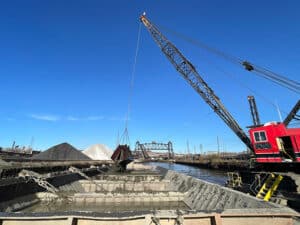
John G Munson coal offloadingFEBRUARY 5, 2013 — A comprehensive report released today has defined the modal and environmental advantages of using marine shipping to transport goods in the Great Lakes-St. Lawrence Seaway region.

The study, entitled "The Environmental and Social Impacts of Marine Transport in the Great Lakes-St. Lawrence Seaway Region" was conducted by Ontario transportation consultants Research and Traffic Group, and peer reviewed by independent experts in the U.S. and Canada.

The study found that Great Lakes ships are more fuel-efficient and emit fewer greenhouse gases per thousand cargo-ton miles than land-based alternatives.

The study also calculated that a shift from marine to road and/or rail modes of transport would lead to increased societal impacts including additional traffic congestion, higher infrastructure maintenance costs, and significantly greater levels of noise.

This bi-national research project is the first time a study has examined the external impacts of the U.S., Canadian, and international fleets operating on the navigation system, using actual data from all three categories of shipowners. Previous studies of the three modes of transport drew comparisons based on the average performance of each mode, rather than making a like-for-like comparison based on each mode carrying the same cargo mix.

According to marine industry stakeholders, the study's results underscore the importance of investing in the infrastructure and technology required to foster growth in Great Lakes-Seaway transportation.

Steven A. Fisher, Executive Director of the American Great Lakes Ports Association, said: "The study findings present a more complete picture of shipping in the Great Lakes in terms of the benefits of this mode of transportation. Data from the study will help inform future decisions on subjects ranging from investments in new technologies, budget allocations for infrastructure projects, and appropriate levels of regulation, to name just a few. The marine industry now has the information it needs to address questions by federal and state governments on the value of shipping to its constituents."

Mark W. Barker, President, The Interlake Steamship Company, added that the study provides additional foundational data that will help the Great Lakes marine industry continue to reduce its environmental footprint.  He said, "Interlake was pleased to be part of this groundbreaking study. As a company, we are committed to minimizing the impact our fleet has on the environment. Our vessels carry more than 20 million gross tons annually, and do so using significantly less fuel per ton than it would take to move the same cargo by land-based modes. With continual improvement programs, new technologies, and regulatory changes we see the benefits of marine shipping increase in the future."

In terms of energy efficiency and greenhouse gas emissions, the study finds that:

  • The Great Lakes-Seaway fleet is nearly 7 times more fuel-efficient than trucks and 1.14 times more fuel-efficient than rail.
  • Rail and trucks would emit 19 percent and 533 percent more greenhouse gas emissions respectively if these modes carried the same cargo the same distance as the Great Lakes-Seaway fleet.

The study also emphasizes the significant role that marine shipping plays in reducing congestion on roads and railways:

  • It would take 3 million train trips to carry the total cargo transported by the Great Lakes-Seaway fleet in 2010, as much as double the existing traffic on some rail lines in Canada and at least a 50 percent increase in traffic on some of the busiest lines in the U.S.
  • It would take 7.1 million truck trips to carry the total cargo transported by the Great Lakes-Seaway fleet in 2010. That would increase existing truck traffic by between 35 to 100 percent depending on the highway.
  • If Great Lakes-Seaway marine shipping cargo shifted permanently to trucks, it would lead to $4.6 billion in additional highway maintenance costs over a 60-year period.

An additional assessment gauged the long term efficiency and emissions performance of Great Lakes vessels after meeting new regulatory standards and achieving improvements with new technology and the use of low sulfur fuels between 2012 to 2025. The Great Lakes-Seaway fleet would record significant decreases in emissions as follows:

  • GHG emission reductions of 32 percent
  • NOx emission reductions of 86 percent
  • SOx emission reductions of 99.9 percent
  • Particulate Matter emission reductions of 85 percent

An Executive Summary of the study available HERE


Page 22 of 46

Banner